





In Bangladesh’s garment sector, firms often under-promote women because of biased beliefs and distorted learning about women’s managerial ability. However, temporary, low-risk trials can correct these beliefs and lead to sustained increases in female supervisors even when initial performance appears weaker.
Editor’s note: For a broader synthesis of themes covered in this article, check out Issue 2 of our VoxDevLit on Female Labour Force Participation.
Bangladesh’s ready-made garment sector has transformed women’s economic opportunities, increasing paid employment and shifting life-cycle outcomes in ways that few policies have matched (Heath and Mobarak 2015, Heath et al. 2025). But women have remained trapped at the bottom: they are heavily represented among sewing-machine operators but remain scarce in even the first managerial layer – line supervisors. This matters for both equity and efficiency. Almost the entire gender wage gap in the sector is due to women lacking access to internal promotions to supervisory roles (Menzel and Woodruff 2021). Furthermore, line supervisors are crucial to productivity because they allocate tasks, troubleshoot bottlenecks, ensure quality, and mediate between workers and production managers (Adhvaryu et al. 2023).
A broader evidence base shows that exposure to women in leadership can shift beliefs and behaviour. For example, in Indian villages, women-led councils changed what communities view as feasible for women, raising girls’ aspirations and educational attainment (Beaman et al. 2009). But we know much less about how this learning process works inside firms – especially where authority is contested, and productivity depends on cooperation from co-workers and subordinates.
We (Macchiavello, Menzel, Rabbani, and Woodruff 2025) study what happens when factories are encouraged to ‘try’ women as supervisors. We construct a straightforward model of experimentation and learning to interpret the results of a randomised controlled trial that encouraged factories to experiment with assigning women to supervisory roles. Our empirical findings show how firms, even those operating in highly competitive environments, can remain trapped with wrong beliefs that lead to misallocation of managerial talent, and why experimentation and learning can narrow the supervisory gender gap – even when short-run performance looks discouraging.
Our key findings are as follows:
- Pessimistic beliefs about women’s skills, or about how co-workers and subordinates would react to their promotion, can discourage experimentation and learning, leading to ‘too few’ women supervisors, even if women’s underlying skills are similar.
- The experiment generates the kind of information managers need to update beliefs about women’s supervisory performance.
- Short-run productivity gaps can be self-fulfilling if co-workers’ beliefs reduce cooperation with female supervisors, suggesting that early underperformance is not decisive evidence of lower ability.
- By correcting beliefs, a temporary push to experiment can shift promotion decisions in a durable way, increasing women’s representation in supervision. However, experimentation is risky and a public good, and will generally be under-provided, particularly in high-pressure supply chains.
A simple theory of promotion under biased beliefs
We begin with a familiar puzzle: if firms are profit-maximisers and women are capable, why do we observe so few women supervisors? A canonical answer involves either taste-based or statistical discrimination. Our framework focuses on a particular belief-based channel and clarifies the role of experimentation.
Think of a production line’s output under a given supervisor as having two components:
- What the factory can see ex ante about a candidate (call this ‘talent’): technical knowledge, reliability, and basic management skills.
- What the factory is uncertain about ex ante: the ‘net bias’ the supervisor will face from co-workers and subordinates, which affects realised performance. This captures how the rest of the workforce reacts to the experiment, including resistance to a woman’s authority, lower cooperation, weaker information sharing, or other frictions that reduce productivity.
Our model treats this second component as uncertain for female candidates and allows managers to learn about it by trialling a woman in a supervisory role and observing performance. Importantly, the model distinguishes:
- the decision-maker’s own preferences (which we assume not to be taste-discriminatory) from
- the bias embedded in the organisation (co-workers, subordinates, or the broader environment), which affects the realised productivity of female supervisors.
This introduces a trade-off for the manager: promoting a man may yield a safer, more predictable short-run outcome, while promoting a woman generates information that can improve future appointments. Whether experimentation is worthwhile depends on three intuitive forces:
- How valuable the future is: how much the firm cares about learning today to make better promotions tomorrow.
- How pessimistic the manager initially is, for example, about how much organisational bias a woman will face.
- How informative the experiment is: does trying a woman actually reveal whether the environment will accommodate her authority?
A central implication is a ‘hurdle’ result: absent experimentation, a woman must look strictly better than a man to be promoted. With experimentation, that hurdle can shrink, because the value of information offsets short-run risk. But if managers are sufficiently pessimistic (or discount the future heavily), they may avoid experimenting, leaving the firm stuck in an equilibrium with too few women supervisors – even if the efficient share is higher.
This is the lens through which the intervention is designed: temporarily lower the barrier to experimentation and see whether learning moves factories towards a new promotion equilibrium.
How the experiment creates information for managers
We partnered with 24 large garment factories and asked managers to nominate male and female operators who were on the margin of promotion to line supervision. Candidates attended a structured training programme. The key experimental step was a two-month trial period: trainees served as co-supervisors on production lines, and within each factory, trainees were randomly assigned to lines so that lines were randomly assigned to receive a male or female trainee.
The random assignment matters because it creates a clean comparison of line productivity during the trial, while also generating precisely the kind of ‘signal’ managers use in practice: observed performance when someone is placed in authority.
We combine diagnostic tests of skills; surveys of beliefs about women’s supervisory ability among managers, supervisors, and workers; daily line-level production data (efficiency); and post-trial outcomes.
What we find, interpreted through the theory
- Women and men look similar on what firms can observe ex ante
On a broad diagnostic battery – literacy, reasoning, communication, leadership – female and male trainees look broadly similar. Women do worse on numeracy and report lower confidence at baseline, but confidence gaps narrow after training. Importantly, men and women score similarly on technical understanding of production, arguably the most important skill for a supervisor.
In the model’s language, the ‘talent’ component factories can observe ex ante is not systematically lower for women. This weakens the simplest ability-based account of the missing rung.
- During the trial, lines assigned female trainees are less efficient
During the two-month trial, lines randomly assigned to female trainees have lower efficiency than those assigned to male trainees. The gap is economically meaningful.
On its own, this could be read as evidence of lower female supervisory ability. The theory explains why that inference can be wrong: trial performance is a joint product of the trainee and organisational environment. If co-workers resist female authority, trial performance will understate women’s potential in a less biased environment and will also feed back into managers’ beliefs.
- The productivity gap is tightly linked to beliefs, consistent with self-fulfilling bias
We directly measure baseline beliefs about whether women make good supervisors. Beliefs are negative towards women across the hierarchy. Figure 1 shows that the ‘female penalty’ is substantially larger on lines where incumbent co-supervisors hold more negative beliefs about women’s supervisory ability.
This is exactly the kind of channel the model is built to capture: a negative ‘bias term’ that depresses realised performance for female supervisors, and therefore shapes both current productivity and what managers learn from experimentation. In other words, initial underperformance can be endogenous to pessimistic beliefs.
Figure 1: Beliefs among co-supervisors and productivity of trainees during trial
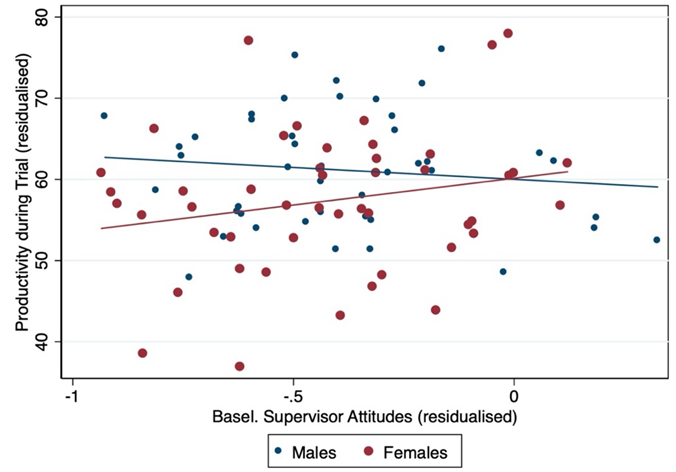
Notes: Productivity during the trial period of lines randomly selected to receive male trainees (blue dots) or female trainees (red dots) against the average beliefs among the baseline team of line supervisors on the line before the arrival of the trainee.
- After the trial, many women are retained, and those retained perform like men
After two months, factories decide whether to retain trainees as supervisors. Many women are retained. Conditional on retention, female trainees perform similarly to male trainees after the trial. This pattern is consistent with learning: managers identify effective female supervisors and keep them. It is also consistent with organisational adaptation: once a woman remains in a supervisory role, co-workers may update their own beliefs and behaviour, reducing the bias component that depressed trial performance.
We also show evidence that factories participating in a follow-on training programme promote additional women to supervisory positions beyond those trained in the programme and promote at a higher rate than a group of comparable factories not participating in the training (see Figure 2).
Figure 2: Long-run share of female supervisors
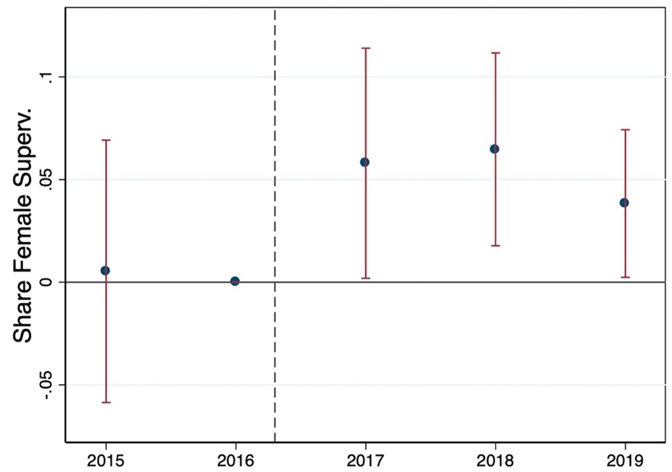
Notes: This figure plots year-by-year estimates of the difference in changes in the female-supervisor share between factories that participated in a follow-on ‘extension trial’ and factories that did not participate in any trials, using Better Work data for 2015–2019. A vertical dashed line marks the implementation period of the extension trial.
Why the theory changes how we read the evidence
The empirical facts are not unusual in discrimination settings: similar observed skills, poorer initial performance, partial retention, longer-run change. Our theoretical contribution is to show why these facts fit naturally with a model of learning under biased organisational responses.
- If managers are pessimistic and do not experiment, they never generate the information required to revise beliefs.
- If co-workers’ beliefs reduce cooperation with female supervisors, early performance is partly a reflection of the environment rather than ‘true ability’.
- A forced or subsidised experiment can generate information that shifts beliefs and promotion patterns, even if the first experiment looks imperfect.
For policy and practice, the implication is not simply ‘train women’. It is to design low-risk organisational experiments that allow firms to learn about female supervisory talent, and to reduce the self-fulfilling effects of biased beliefs. If the constraint is managerial learning – and the organisation’s willingness to update – then carefully structured trials can move firms towards a new equilibrium.
References
Adhvaryu, A, A Nyshadham, and J Tamayo (2023), “Managerial quality and productivity dynamics,” Review of Economic Studies, 90(4): 1569–1607.
Beaman, L, R Chattopadhyay, E Duflo, R Pande, and P Topalova (2009), “Powerful women: Does exposure reduce bias?” Quarterly Journal of Economics, 124(4): 1497–1540.
Heath, R, and A M Mobarak (2015), “Manufacturing growth and the lives of Bangladeshi women,” Journal of Development Economics, 115: 1–15.
Heath, R, A Bernhardt, G Borker, A Fitzpatrick, A Keats, M McKelway, A Menzel, T Molina, and G Sharma (2025), “Female labour force participation,” VoxDevLit, 11(2).
Macchiavello, R, A Menzel, A Rabbani, and C Woodruff (2025), “Promoting women to managerial roles in the Bangladeshi garment sector,” Unpublished manuscript.
Menzel, A, and C Woodruff (2021), “Gender wage gaps and worker mobility: Evidence from the garment sector in Bangladesh,” Labour Economics, 71.