







A religious television broadcast strengthened Hindu identity in 1980s India, catalysing lasting electoral shifts, conflict, and institutional change.
Every Sunday morning in 1987, India came to a standstill. Streets emptied. Shops closed. Families bathed and adorned their television sets with flowers before gathering – often with neighbours – to watch Ramayan, a televised retelling of the ancient Hindu epic. An estimated 80 million viewers tuned in weekly, making it the most-watched programme in Indian television history (Rajagopal 2001). This shared cultural moment would reshape the country's politics for years to come. We study Ramayan’s impacts, finding that exposure to the show caused strengthened Hindu religious identification, short-term increases in communal violence, and persistent electoral gains for the Bharatiya Janata Party, even though the Congress government aired it mainly to boost advertising revenue rather than for ideological reasons.
How can one determine the causal impact of Ramayan? Our key insight is that television signals do not travel uniformly: hills and valleys create natural barriers that weaken reception in some areas, while others receive strong signals. This variation, driven by terrain and the timing of transmitter rollout rather than systematic differences across places, allows us to estimate the causal effect of exposure to Ramayan by comparing changes over time in places that had a stronger TV signal in 1987 when the show aired to places that had weaker or no signal (Yang, Saia, Kovvuri, Ahmed, and Brimble 2026).
A growing evidence base shows that mass media can shape religious beliefs and behaviour (Grosfeld et al. 2024, Mello and Buccione 2023, Wang 2021). We show that exposure to religious media can shift religious identification, with cascading consequences across multiple domains – from personal choices to intergroup conflict to electoral politics to institutional change. Crucially, we show how temporary shocks can generate self-reinforcing dynamics, as in political economy models of social identity (Sambanis and Shayo 2013, Besley and Persson 2021): identity changes drive political realignment, which enables institutional developments (Hindu religious schools) that perpetuate the initial catalyst. This feedback mechanism helps explain why an 18-month television broadcast had effects that persisted for more than a decade.
A television show that was an unprecedented phenomenon with unintended consequences
The tale of Ramayan itself was well-known and existed in countless regional variations across India. But for the first time, one version was broadcast to a mass national audience, creating a shared cultural experience. The viewing often took on ritualistic features as people bathed and adorned their television sets with flowers and sandalwood before the show began (Mitra 1993).
Notably, Ramayan was aired on Doordarshan, India's sole state-run television channel controlled by the Congress government. The show was approved to boost advertising revenue and not for ideological reasons (Rajagopal 2001), and succeeded spectacularly, becoming the broadcaster's top earner (Lutgendorf 1990).
The broadcast happened in the midst of rapid expansion of India's television network, with new transmitters bringing television to millions of households for the first time. We exploit this rollout – and the natural variation in signal strength created by topography – to measure the causal effect of exposure to a cultural event that heightened religious identity.
Measuring exposure to the television show: Terrain as a natural experiment
Television signals do not travel uniformly. Irregular topography (mountains and valleys) creates interference, leading to variation in TV signal strength. We calculate a locality’s TV signal strength using an Irregular Terrain Model (ITM), a telecommunications model increasingly used in social science to study media effects (Olken 2009, Yanagizawa-Drott 2014).
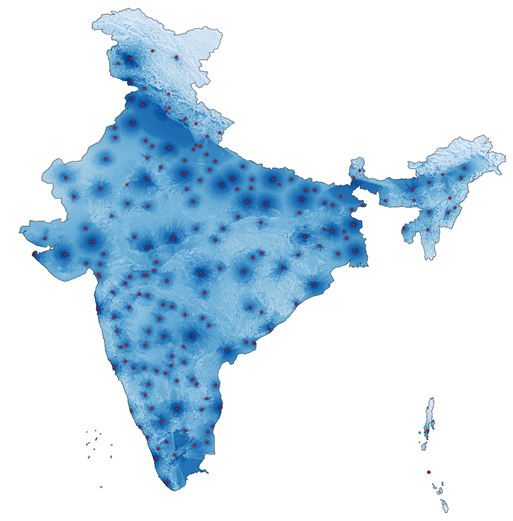
We collected archival data on every television transmitter built in India from the 1970s through the 1990s: locations, construction dates, and technical specifications. Applying ITM with high-resolution terrain data, we calculate predicted signal strength reaching each locality in 1987. Crucially, we control for straight-line distance from transmitters (which captures proximity to urban centres), isolating variation that comes purely from topographical barriers. Figure 1 shows the resulting coverage based on 1987 transmitters.
Figure 1: 1987 television coverage
We assemble panel data on outcomes across 4,000 localities (Legislative Assembly Constituencies) from 1979–2000. This allows us to control for location-specific characteristics and to show that areas with different levels of Ramayan exposure followed parallel trends before 1987. We also used the ITM to calculate local TV signal for all years of our analysis, not just 1987, allowing us to confirm that it is Ramayan specifically, not general TV access, driving the effects.
Strengthening religious identification: The evidence from names and consumption
We measure changes in religious identity by tracking behavioural markers. First, we examine names – powerful markers of identity. A growing body of research uses naming patterns to measure cultural assimilation and identity formation (Esposito et al. 2023, Bazzi et al. 2020, La Ferrara et al. 2012). If Ramayan strengthened Hindu identity, we should see more families converging on traditional Hindu names.
Using electoral roll data, we create our names outcome: whether Hindu families gave newborns one of the ten most common Hindu names in their state during the pre-Ramayan period (1900–1970). Increased use of these traditional names signals strengthened Hindu identification.
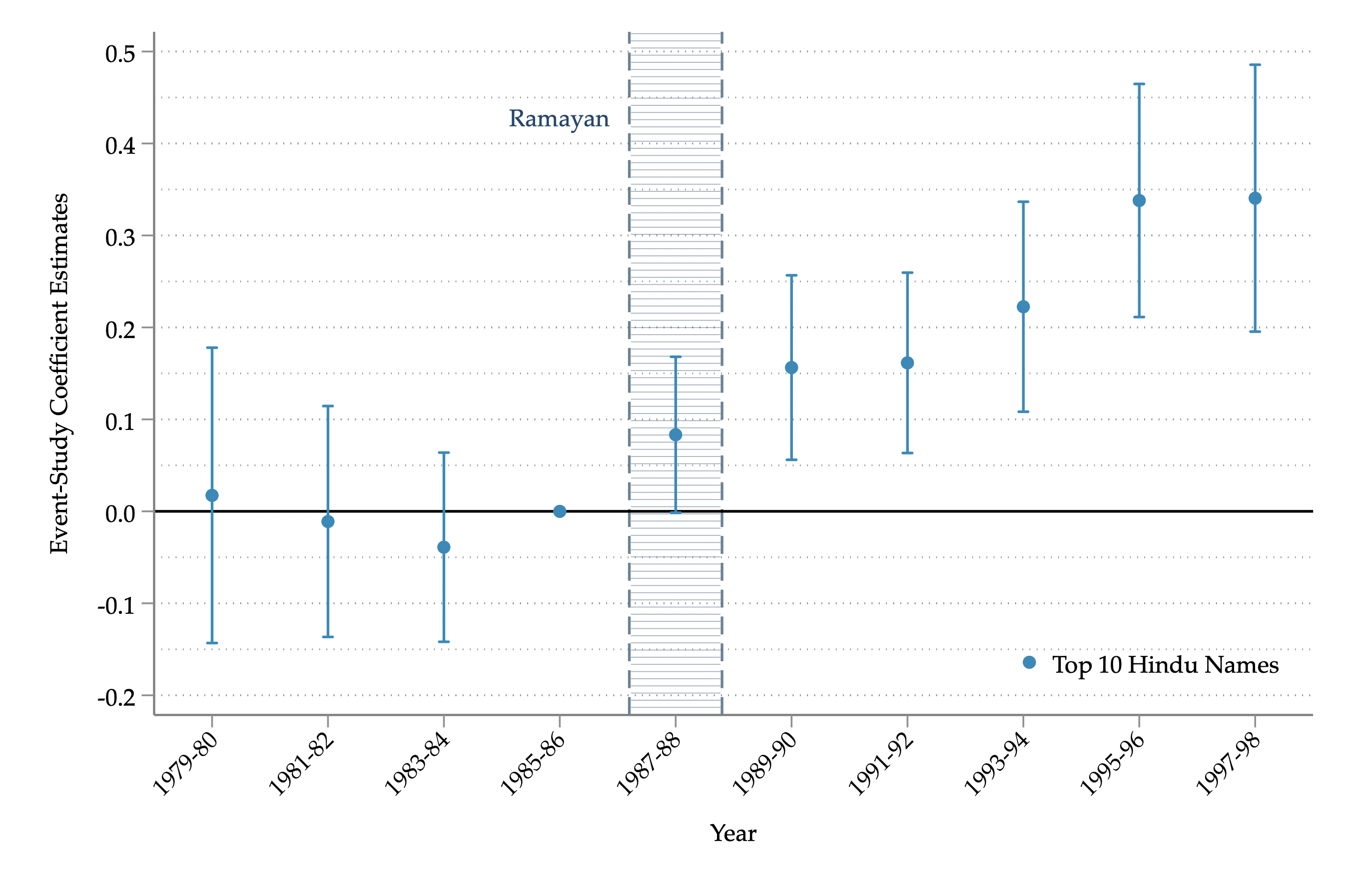
Figure 2 shows the event study of the impact of Ramayan exposure on naming patterns. Prior to 1987, there is no effect of future Ramayan exposure on naming patterns – the parallel trend assumption holds. Following the broadcast, the trends diverge across regions with varying levels of exposure. Areas with stronger exposure see a sharp increase in parents choosing common Hindu names, and this effect increases in magnitude over the subsequent decade.
Figure 2: Impacts of Ramayan on the percentage of Hindu male newborns given top 10 names
Dietary practices provide complementary evidence. Vegetarianism has long been associated with upper-caste Hindus. Lower-caste adoption is a classic example of ‘Sanskritisation’ (Srinivas 1962) – the emulation of upper-caste practices to signal religious status. Using household consumption data, we find lower-caste Hindu households in high-exposure areas were significantly more likely to adopt vegetarianism: a 14.4 percentage point increase from a base of 38%. Ramayan exposure substantially reduces the vegetarianism gap between lower and upper castes.
From identity to conflict, politics, and institutions
Strengthened religious identity did not remain an isolated cultural shift. It had concrete consequences for intergroup relations and politics.
Figure 3
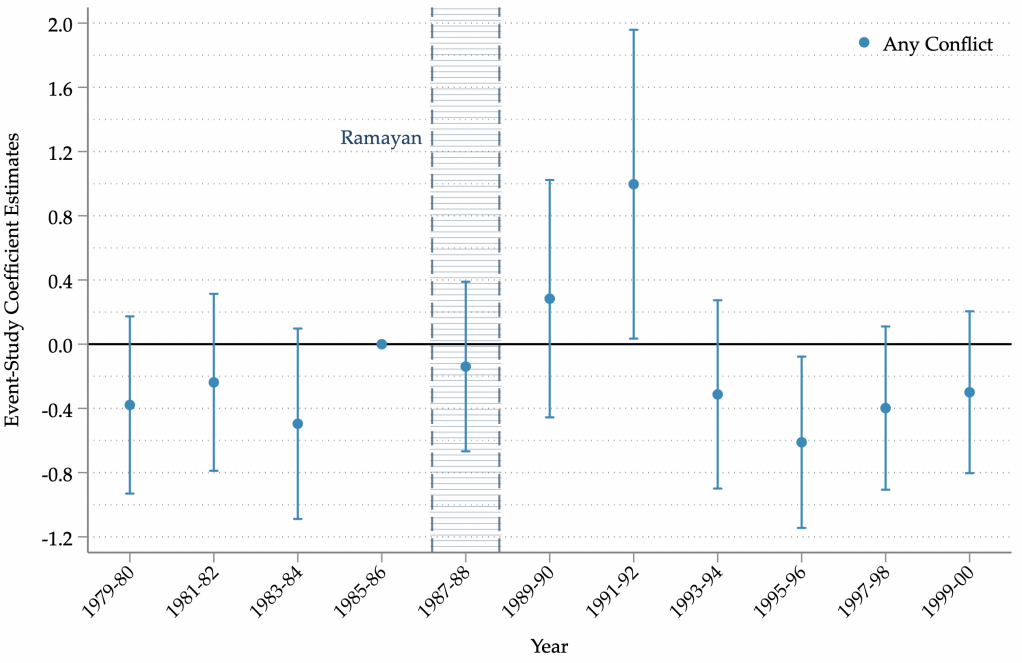
Panel A: Impacts of Ramayan on Hindu-Muslim conflict
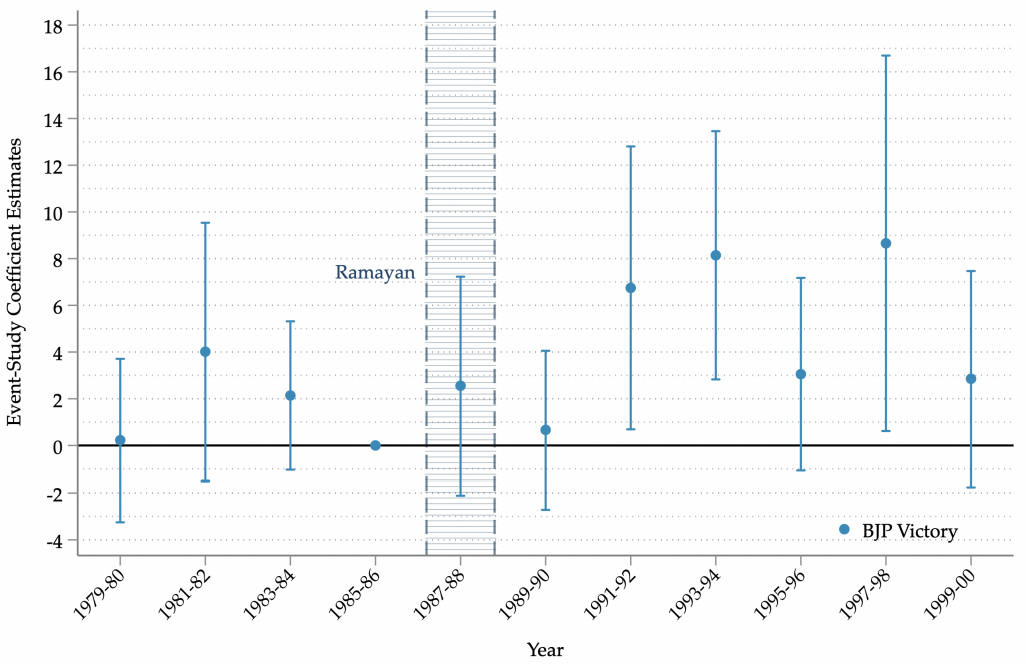
Panel B: Impacts of Ramayan on BJP state assembly victory
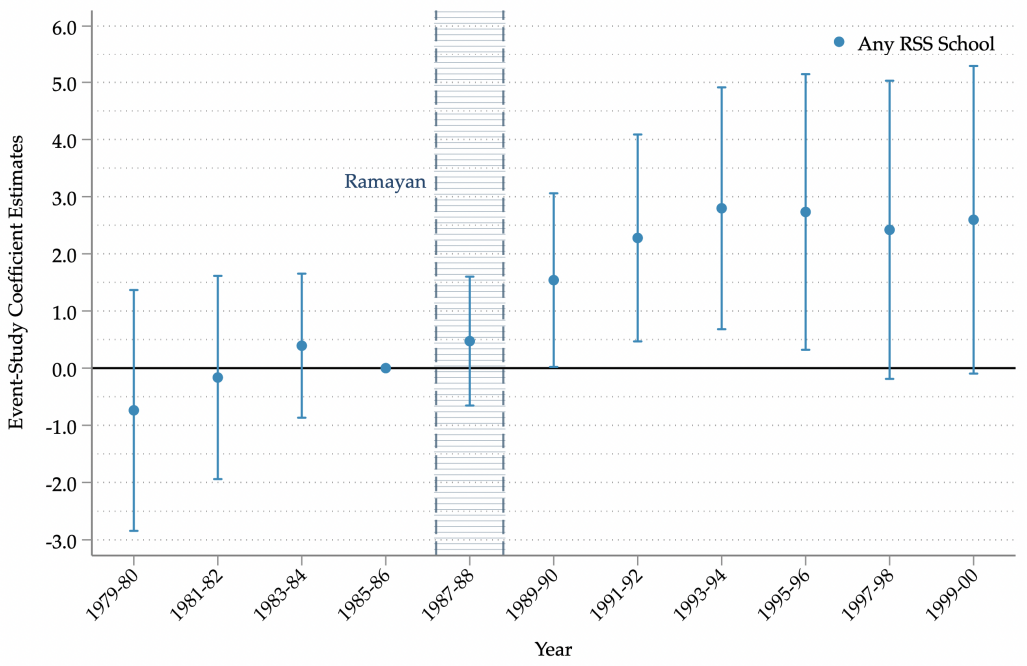
Panel C: Impacts of Ramayan on RSS schools
Communal violence
Strengthened religious identification increased the likelihood of violence in 1991–92, at the peak of the Ram Janmabhoomi movement (Kalra 2021, Blakeslee 2018). During this period, places with greater Ramayan exposure and thus heightened salience of religious identity were more likely to experience conflict (Figure 3A).
Electoral consequences
Ramayan exposure led to large and persistent electoral gains for the Bharatiya Janata Party (BJP). Figure 3B shows BJP victory rates increasing in high-exposure areas, with effects persisting throughout the 1990s.
The effects survive multiple robustness checks. They remain when controlling for television access in other years, confirming it’s Ramayan specifically – not general TV access – driving results. They persist when restricting analysis only to areas receiving large TV signal improvements due to the mid-to-late 1980s transmitter rollout, addressing concerns about systematic differences between early and late TV adopters. We further show that concurrent political movements, such as the Ram Janmabhoomi mobilisation, do not drive the effects.
How temporary shocks become permanent: The role of institutions
How did a TV series lasting just 18 months have such persistent effects? We find evidence of a feedback mechanism through institutional change (Figure 4). Using data on roughly 9,000 schools established by RSS, the ideological parent organisation of the BJP, we document that areas with higher Ramayan exposure became significantly more likely to have such schools in subsequent years (Figure 3C). These patterns are consistent with both political supply responses and increased local demand. These institutions represent a concrete channel through which temporary media exposure generated lasting political change.
Figure 4: Conceptual framework: Ramayan’s effects on cultural identity and political outcomes
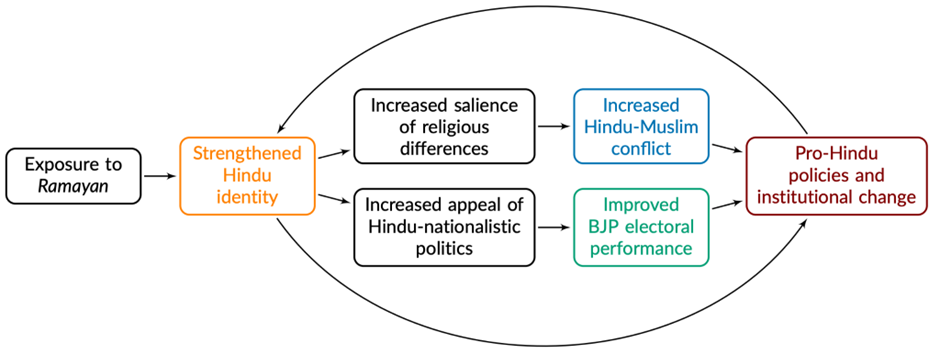
Our findings offer lessons for understanding how shifts in identity can change society and politics in the long run. A single television show, aired for just 18 months, reshaped India's political landscape for years afterwards. The mechanism matters: strengthened identity triggered political realignment, which enabled institutional changes (religious schools) that perpetuated the initial shock. This feedback loop – from media to identity to politics to institutions and back – helps explain why temporary cultural moments can have permanent political consequences.
References
Bazzi, S, M Fiszbein, and M Gebresilasse (2020), “Frontier culture: The roots and persistence of ‘rugged individualism’ in the United States,” Econometrica, 88(6): 2329–2368.
Besley, T, and T Persson (2021), “The rise of identity politics,” Unpublished manuscript.
Blakeslee, D (2018), “The Rath Yatra effect: Hindu nationalist propaganda and the rise of the BJP,” Unpublished manuscript.
Esposito, E, T Rotesi, A Saia, and M Thoenig (2023), “Reconciliation narratives: The birth of a nation after the US Civil War,” American Economic Review, 113(6): 1461–1504.
Grosfeld, I, E Madinier, S O Sakalli, and E Zhuravskaya (2024), “Independent media, propaganda, and religiosity: Evidence from Poland,” American Economic Journal: Applied Economics, 16(4): 361–403.
Kalra, A (2021), “A ‘ghetto’ of one’s own: Communal violence, residential segregation and group education outcomes in India,” Unpublished manuscript.
La Ferrara, E, A Chong, and S Duryea (2012), “Soap operas and fertility: Evidence from Brazil,” American Economic Journal: Applied Economics, 4(4): 1–31.
Lutgendorf, P (1990), “Ramayan: The video,” Drama Review, 34(2): 127–176.
Mello, M, and G Buccione (2023), “Religious media, conversion, and the socioeconomic consequences: The rise of Pentecostals in Brazil,” Unpublished manuscript.
Mitra, A (1993), “Television and the nation: Doordarshan’s India,” Media Asia, 20(1): 39–44.
Olken, B (2009), “Do television and radio destroy social capital? Evidence from Indonesian villages,” American Economic Journal: Applied Economics, 1(4): 1–33.
Rajagopal, A (2001), Politics after television: Hindu nationalism and the reshaping of the public in India, Cambridge University Press.
Sambanis, N, and M Shayo (2013), “Social identification and ethnic conflict,” American Political Science Review, 107(2): 294–325.
Srinivas, M N (1962), Caste in modern India, and other essays, Asia Publishing House.
Wang, T (2021), “Media, pulpit, and populist persuasion: Evidence from Father Coughlin,” American Economic Review, 111(9): 3064–3092.
Yanagizawa-Drott, D (2014), “Propaganda and conflict: Evidence from the Rwandan genocide,” Quarterly Journal of Economics, 129(4): 1947–1994.
Yang, D, A Saia, A Kovvuri, R Ahmed, and P Brimble (2026), “Ancient epics in the television age: Religious identity and the rise of Hindu nationalism in India,” Unpublished manuscript.