








Evidence from Ukraine shows that civilians’ failure to evacuate during war is driven mainly by practical barriers rather than psychological resistance, with clear information and organised transport proving more effective than behavioural ‘nudges’ in encouraging people to leave.
Editor’s note: For a broader synthesis of themes covered in this article, check out our VoxDevLit on Refugees and Other Forcibly Displaced Populations.
Each year, tens of thousands of people die in armed conflicts (Herre et al. 2024). Many of these deaths could be prevented through timely evacuation. Yet despite clear warnings and obvious risks, people often refuse to leave. Why do they stay? And what can authorities do to encourage life-saving evacuations? With approximately 50 active conflicts worldwide, governments and humanitarian organisations regularly face the challenge of moving civilians out of harm's way.
Studying evacuation decisions
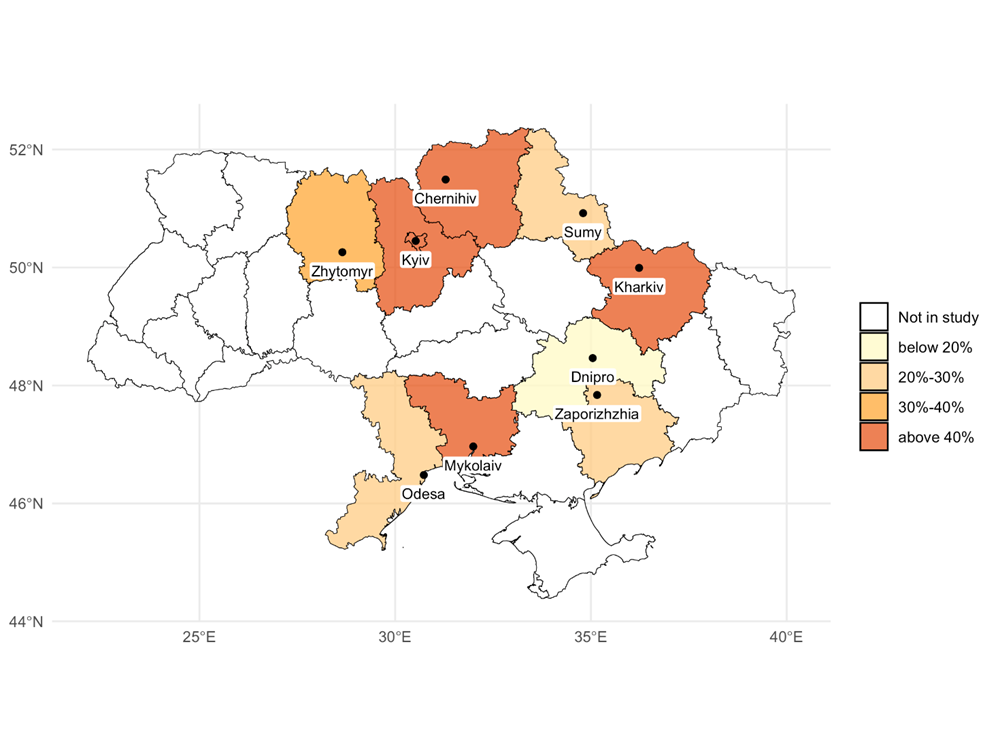
We conducted an extensive survey, including an experiment to make causal inferences, in Ukraine during the active armed conflict in July 2022. The survey took place five months after Russia's full-scale invasion, with over 2,000 participants (Martinez et al. 2025). We recruited participants from ten Ukrainian oblasts that had been invaded by Russian ground forces or consistently shelled. Threats to these oblasts were not hypothetical: 82% of respondents reported perceiving a genuine risk of being injured or killed by missile strikes on their homes. About 40% had already evacuated at some point since the invasion began, and at least half of those who stayed had considered leaving. Figure 1 shows the oblasts included in the study and the proportion who had evacuated (including those who afterwards returned) by the time of the study.
Figure 1: Share of respondents who had evacuated (including those who evacuated and returned) by July 2022
Source: Martinez et al. (2025).
Evidence from evacuation decisions
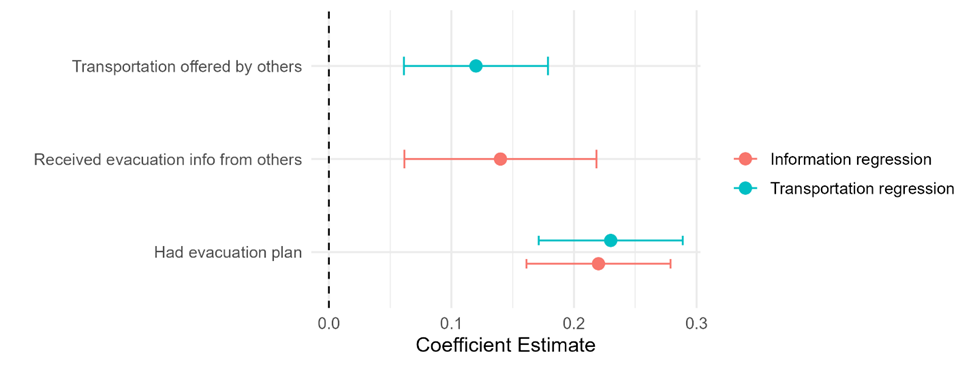
We asked respondents about their evacuation behaviour at the start of the invasion. Some of the people evacuated to a safer place within Ukraine, some left the country, some left to evacuate members of their families and later returned, and some never left. In addition, we elicited demographic characteristics and asked to what extent participants had considered or planned for evacuation. The data shows that receiving evacuation information or a transportation offer from others, including friends, relatives, colleagues, neighbours, and local authorities, strongly predicts whether someone evacuates. Both are associated with roughly a 10–20% higher likelihood of evacuation. Similarly, having an evacuation plan in place immediately before the start of the full-scale invasion is also strongly correlated with eventual evacuation – those who had a plan were approximately 20% more likely to evacuate. Figure 2 shows coefficient estimates from the corresponding regressions. These relationships remain robust when controlling for demographics and region of residence.
Figure 2: Coefficients of a regression with evacuation status as dependent variable (1 = yes)
Source: Martinez et al. (2025).
Considering these results, it seems that practical information, opportunity, and preparedness play key roles in people’s decisions to evacuate. Natural questions to ask are then what factors determine people’s preparedness, and which parts of the population react most strongly to information or transport offers. This information would allow authorities to better target their evacuation efforts. Our data shows that having sufficient disposable income and owning a vehicle make it significantly more likely to be prepared to evacuate. This underlines the findings that practicalities such as means and opportunities play a key role. We furthermore see that women are less likely to have their own evacuation plans in place than men.
In line with this, when we analyse who reacts most strongly to receiving evacuation information or transportation offers, women react much more strongly than men. These results suggest that authorities or volunteers should target those without their own means and women with information about evacuation opportunities and arranged transport.
While the patterns observed in the survey data are intuitive, the findings discussed thus far are correlational in nature and not based on an experimental treatment variation. However, in addition to regular survey questions, we also present experimental evidence.
Causal evidence from a controlled experiment
Our experiment served two purposes. First, it can be used to check the consistency between the correlational findings on actual evacuation decisions and causal findings on hypothetical evacuation decisions. It turned out that the experimental results on the perceived effectiveness of evacuation messages and the correlational evidence on actual evacuation behaviour tell a coherent story: practical constraints, not psychological resistance, are the primary barrier to evacuation for many civilians. Second, the experiment serves its own goal: to analyse the design of evacuation messages. Technology allows authorities to send alerts via text messages and apps within seconds. But what should these messages say?
Behavioural economics offers tools to influence decisions through how choices are presented, often called ‘nudges’ (Thaler and Sunstein 2009). These have shown promise in some contexts, though effects are often modest (Mertens et al. 2022). The closest evidence on evacuation comes from natural disaster research, where social norms messages increased preparedness and evacuation intentions in hypothetical disaster scenarios (Ohtake et al. 2020). But war differs from floods or storms: displacement may be permanent, and threats like occupation have no natural parallel. Whether nudges could encourage evacuation during armed conflict remained untested.
Our findings establish additional limits to standard nudging tools: psychological framing techniques that work in other contexts appear ineffective here. What matters instead is something far more practical: telling people how to get out.
We designed an experiment testing two broad hypotheses about why people do not evacuate. The first is that they choose not to despite being able to, perhaps because they underestimate the risks or overvalue staying put. This suggests that psychological nudges, making dangers more salient or framing choices differently, might help. The second hypothesis is that people want to leave but feel unable to do so on their own. This suggests that practical assistance, not persuasion, is the binding constraint.
Plans work, framing does not
We randomly assigned participants to evaluate one of ten different evacuation messages. Five message types varied the psychological framing:
- A control message modelled on actual Ukrainian evacuation notices
- A 'gain of life' frame emphasising survival benefits of leaving
- A 'loss of life' frame stressing mortality risks of staying
- A 'deteriorating conditions' frame highlighting future shortages of food, water, and medicine
- A 'military effectiveness' frame explaining that evacuation helps the armed forces
Half the messages also included a concrete evacuation plan. The plan stated that free buses would leave from a specific location, with a phone number to reserve a seat. This mirrors the kinds of organised evacuations that local authorities actually conducted during the early stages of the invasion.
Participants rated how effective they thought each message would be at convincing residents of their city to evacuate, on a scale from 0 to 10.
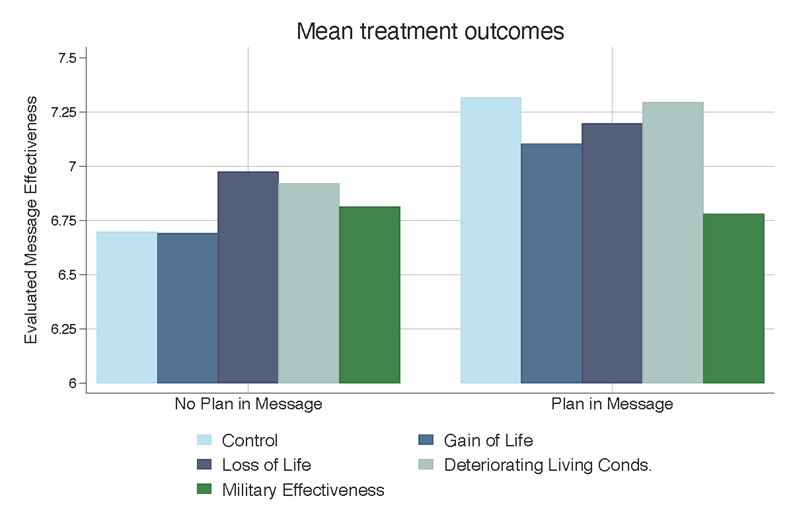
The results were clear (see Figure 3). None of the psychological framing treatments had any significant effect on perceived message effectiveness compared to the control. Loss aversion, salience of consequences, appeals to collective benefit: none of these standard behavioural messaging approaches moved the needle.
Figure 3: Experimental treatment effects
Source: Martinez et al. (2025).
The provision of an evacuation plan, however, significantly increased perceived effectiveness by approximately 5%. The effect was strongest among respondents who had not previously evacuated, precisely the population that policymakers most needed to reach.
The null effect of framing may seem surprising given the success of nudges in other domains, from retirement savings to COVID-19 vaccination (Thaler and Sunstein 2009, Dai et al. 2021). In those contexts, nudges work partly by making distant or abstract risks feel more immediate. But respondents living through an active invasion likely did not need to be reminded that staying was dangerous.
This interpretation aligns with a broader lesson from research in behavioural economics. Nudges work best when people face complex choices with delayed consequences and limited attention. In a war zone, the stakes are immediate and obvious. What people often lacked was not motivation but means.
Implications for policymakers
The war in Ukraine continues, and so do dozens of other armed conflicts around the world. Our findings have direct implications for governments, militaries, and humanitarian organisations designing civilian evacuation strategies.
- Organised evacuations matter. Our results suggest that many civilians wanted to leave but felt unable to arrange evacuation themselves. Free transportation, clear meeting points, and reservation systems can make the difference between a warning that is ignored and one that saves lives. In July 2022, an estimated 350,000 civilians remained in Ukrainian-controlled parts of Donetsk oblast alone. Even a modest increase in evacuation rates may translate into thousands of people moved to safety.
- Target those without the means to arrange an evacuation for themselves and provide women with information about existing evacuation opportunities.
- Do not waste resources on clever messaging. Authorities can prioritise providing practical information rather than worrying about the exact wording of alerts. A straightforward message with a concrete plan will likely outperform an elaborately framed warning without one: here is a bus, here is a phone number, here is how you get out.
This knowledge has already been put to practice in Ukraine. Two members of our author team were in close contact with officials and volunteers organising and carrying out evacuations on the ground in Eastern Ukraine. In response to the evidence-based advice given, communication to potential evacuees in Donetsk oblast was adjusted: volunteers and the police force started to provide more detailed information about the evacuation process, including about the location and quality of the provided accommodation and the in-kind and monetary allowances that evacuees could expect to receive. According to later feedback from volunteers and officials, the new communication approach enabled them to convince several families to evacuate, who had previously refused to do so.
References
Dai, H, S Saccardo, M A Han, L Roh, N Raja, S Vangala, H Modi, S Pandya, M Sloyan, and D M Croymans (2021), “Behavioural nudges increase COVID-19 vaccinations,” Nature, 597(7876): 404–409.
Herre, B, L Rodés-Guirao, and M Roser (2024), “War and peace,” Our World in Data.
Martinez, S-K, M Pompeo, R Sheremeta, V Vakhitov, M Weber, and N Zaika (2025), “Civilian evacuation during war: Evidence from Ukraine,” Economic Journal, ueaf075.
Mertens, S, M Herberz, U J J Hahnel, and T Brosch (2022), “The effectiveness of nudging: A meta-analysis of choice architecture interventions across behavioral domains,” Proceedings of the National Academy of Sciences, 119(1): e2107346118.
Ohtake, F, K Sakata, and Y Matsuo (2020), “Early evacuation promotion nudges for heavy rain disasters,” Journal of Behavioral Economics and Finance, 13: 71–93.
Thaler, R H, and C R Sunstein (2009), Nudge: Improving decisions about health, wealth, and happiness, Penguin.