

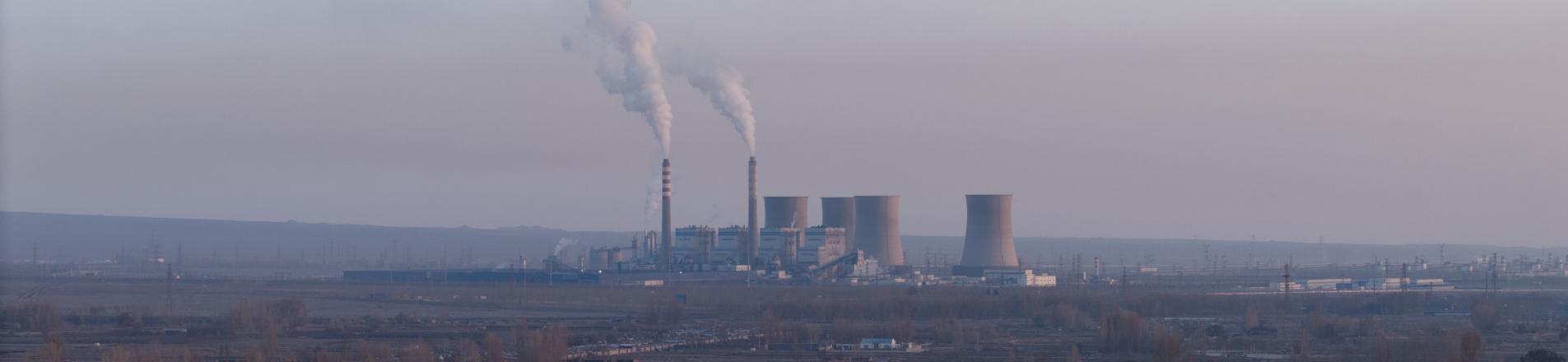


A viral 2015 documentary exposing China's air pollution led to measurable declines in land transaction value and area in more-exposed Chinese cities, as residents reconsidered where to live. The effect was strongest in cities reliant on land-based finance and for lower-quality, peripheral land parcels – suggesting environmental awareness is becoming a fiscal, not just a public health, issue for local governments.
Editor’s note: The authors have made slides available here.
After the release of Al Gore’s environmental documentary An Inconvenient Truth in 2006, individual purchases of voluntary carbon offsets in the US increased substantially over the following two months (Jacobson 2011). In early 2015, the Chinese public was shaken by the online release of Under the Dome, an environmental documentary exposing the severe air pollution problem in the country. The film, produced by the former celebrated state-media investigative journalist Chai Jing, garnered over 200 million views within a single week, sparking intense nationwide debate before it was abruptly censored and removed from the internet after seven days. While previous research has documented the impact of the film on environmental awareness (Tu et al. 2020), our recent study takes a step further by demonstrating that this sudden surge in information had tangible, long-term effects on China’s primary land market (Zou and Liang 2026), which may affect the fiscal revenue of local governments, as they monopolise the primary land market.
The ‘vote with feet’ mechanism
The classic Tiebout (1956) hypothesis suggests that individuals ‘vote with their feet’ by migrating to jurisdictions that better match their preferences for public goods. When residents become acutely aware of air pollution – a public ‘bad’ – they often seek to escape. We hypothesise that when residents decide to move or avoid purchasing housing in polluted cities, the anticipated decline in future residential demand would immediately affect the primary land market, where developers adjust their bidding accordingly.
The impact of environmental awareness on land markets
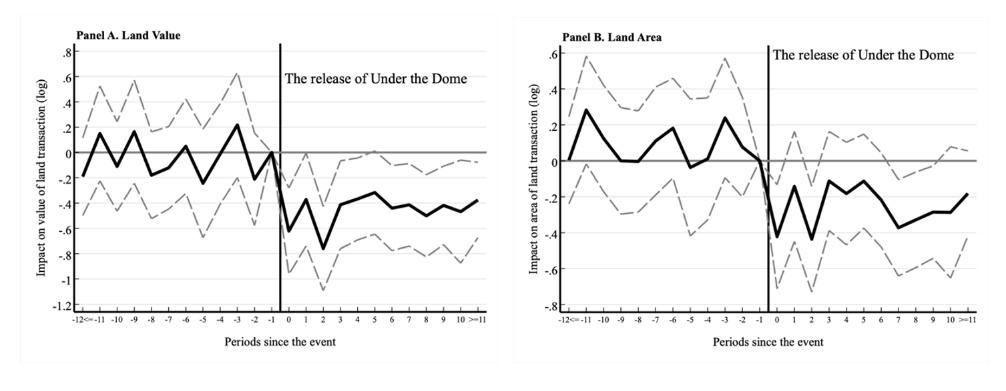
Using a generalised differences-in-difference design and leveraging geographic variation in the exposure to the film, measured by prior online search volume for Chai Jing, we find that increased exposure to the documentary led to a contraction in land transaction activities. Our analysis shows that a 10-percentage-point increase in exposure to the film resulted in a 0.15% lower transaction value and 0.12% less land area leased for commercial and residential use. To address the causality challenge, we used the birthplace of guests in Chai Jing’s signature TV programme prior to her resignation as an instrumental variable. The viewers paid more attention to the guests originally from their locality, so they were more likely to search for Chai Jing and her programme. Meantime, the selection of guests was not related to local environmental quality, as the issue of air pollution was not covered in the programme. Figure 1 summarises the IV estimation of the exposure to the documentary on land transaction activities. It shows that land transaction value and area exhibit a significant reduction in cities with larger exposure to the film.
Figure 1: The dynamic effects on land transaction (IV results)
To put this in perspective, in 2014, total land revenue in China reached CNY 4.26 trillion. Our estimates imply that even a one-standard-deviation increase in exposure could reduce land values by approximately CNY 40.2 billion (roughly US$6.2 billion in 2015), representing a significant fiscal challenge for local governments reliant on land sales.
Who reacts most?
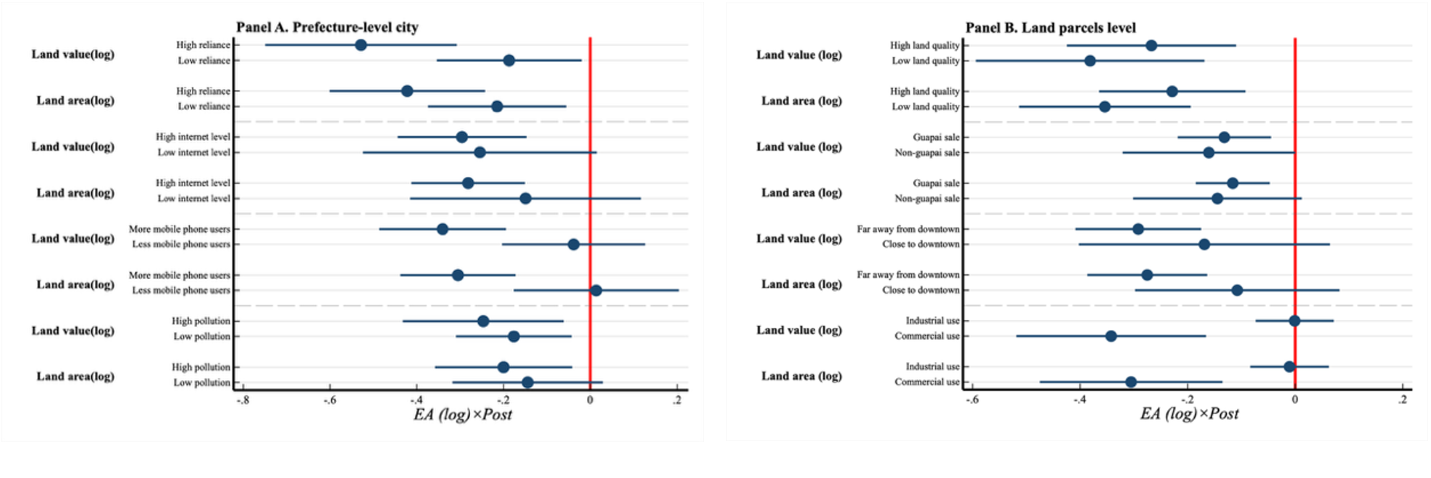
Figure 2 illustrates that our findings are particularly pronounced in specific contexts.
Fiscal reliance: Cities more dependent on land-based finance see sharper declines, as developers likely anticipate a cooling demand for future real estate development.
Digital connectivity: The effect is more salient in cities with higher internet and mobile phone penetration, suggesting that social media serves as a potent tool for rapid information diffusion.
Quality and distance: The impact is largest for low-quality land parcels and those located further from city centres, suggesting that developers are most sensitive to environmental risks when acquiring lower-tier plots.
Figure 2: Heterogeneity analysis
Beyond the data: Migration intentions
To verify the mechanism, we used the National Mobile Population Dynamics Monitoring Survey (NMPDMS). Following the film’s release, residents in highly exposed areas showed a significantly lower willingness to stay in their current cities. Furthermore, search engine data reveals an increase in searches for housing prices in ‘cleaner’ cities compared to ‘dirtier’ ones, providing strong evidence for the voting with feet behaviour.
Takeaways for environmental policy
Our research underscores that information, even when distributed through social media channels under increasingly strict censorship, can act as a powerful market force. Market institutions enable the expression of individual preferences, so that even short-term access to impactful information may change household behaviour and generate sizeable economic and social impacts. When residents are armed with better information about environmental health risks, they alter their consumption and location choices, forcing a recalibration of land demand.
For local governments, this implies that environmental quality is no longer just a public health concern – it is a fiscal one. As citizens increasingly prioritise clean air, the ‘pollution penalty’ on land value may become a permanent fixture, pressuring governments to shift away from land-finance models towards more sustainable development strategies. While we focus on stated migration intentions and search behaviour, the persistent nature of this awareness suggests that the link between environmental perception and economic outcomes is a critical area for future policy planning.
References
Jacobsen, G (2011), "The Al Gore effect: An Inconvenient Truth and voluntary carbon offsets," Journal of Environmental Economics and Management, 61(1): 67–78.
Tu, M, B Zhang, J Xu, and F Lu (2020), "Mass media, information and demand for environmental quality: Evidence from Under the Dome," Journal of Development Economics, 143: 102402.
Tiebout, C (1956), "A pure theory of local expenditures," Journal of Political Economy, 64: 416–424.
Zou, W, and P Liang (2026), "The art of not being chocked: Environmental awareness, residents' responses and land transactions in China," Journal of Development Economics, 182: 103757.