






In Mexico, better management improves firm efficiency, but a range of factors limit well-managed firms from expanding and gaining market share – reducing firms’ incentives to upgrade their practices.
Editor's note: The authors have made slides available here.
Why do so many firms in emerging economies remain badly managed?
Our research on Mexican firms suggests a simple but uncomfortable answer: management pays, but in weak business environments the payoff is too small and too uncertain (Bloom, Iacovone, Pereira-Lopez, Van Reenen forthcoming). Where markets are distorted, even well-managed firms struggle to grow and gain market share. As a result, firms have weaker incentives to invest in improving their management in the first place. This mechanism is not unique to Mexico; it is likely even more important in many low-income economies, where misallocation and institutional frictions remain severe.
A large body of research shows that structured management practices (e.g. systematic monitoring, performance-based incentives, clear targets) are strongly associated with higher productivity, faster growth, better profits, more innovation, and greater export activity (Bloom et al. 2013, Bloom et al. 2019, Scur et al. 2024, Van Reenen 2019). That holds in rich countries and, as our new data confirms, in Mexico too. Using a nationally representative survey of tens of thousands of Mexican firms in manufacturing and services, combined with comparable data for the US, we find that better management goes hand in hand with better performance (Figure 1). In other words, management ‘technology’ works in Mexico just as it does in the US and elsewhere.
Figure 1: Firm performance and management practices in Mexico
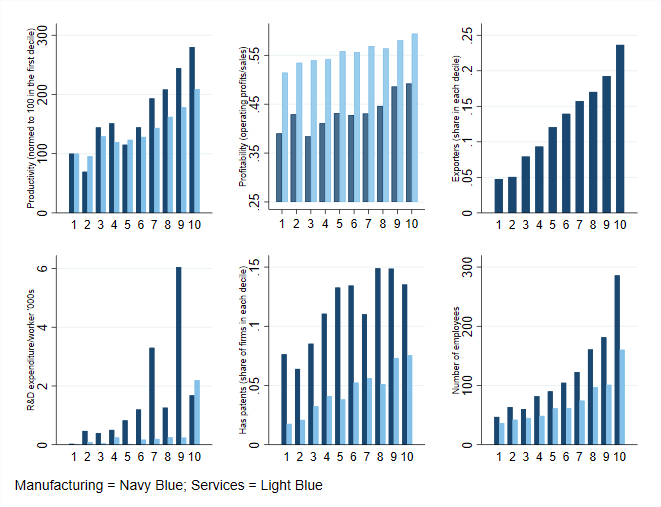
Notes: 6,643 observations on manufacturing firms and 17,684 observations on service firms. Along the x-axis, we measure deciles of the management score.
So, why are average management scores so much lower in Mexico? The usual explanations emphasise managerial supply-side constraints: weak managerial skills, poor business schools, and lack of exposure to modern management ideas. Those factors matter, but they do not tell the whole story. Our contribution is to show that demand-side incentives also play a central role. Even when managers know how to improve their organisation, they may choose not to if the market does not reward their effort.
A demand-side view: When it is not worth the effort to improve management
In a well-functioning market, the logic is simple. Better managed firms raise cost efficiency and/or product quality, enabling them to grow faster and earn higher profits. This chain makes investment in management worthwhile.
In Mexico, the first step of this chain is apparent, as better management is clearly associated with better establishment performance. The problem lies in the next step: better managed firms do not expand as much as we would expect. Market forces are not fully shifting resources, customers, and market share towards them.
Empirically, we proxy this mechanism by assessing the relationship between management and firm size. While in the US, better managed firms are much larger, in Mexico this relationship is systematically weaker, especially in the service sector, where distortions are more pervasive. Figure 2 shows that the relationship between business size (vertical axis) and management score (horizontal axis) is much steeper for American manufacturers than Mexican service firms.
Figure 2: Reallocation – Manufacturing and services, 2014 and 2017
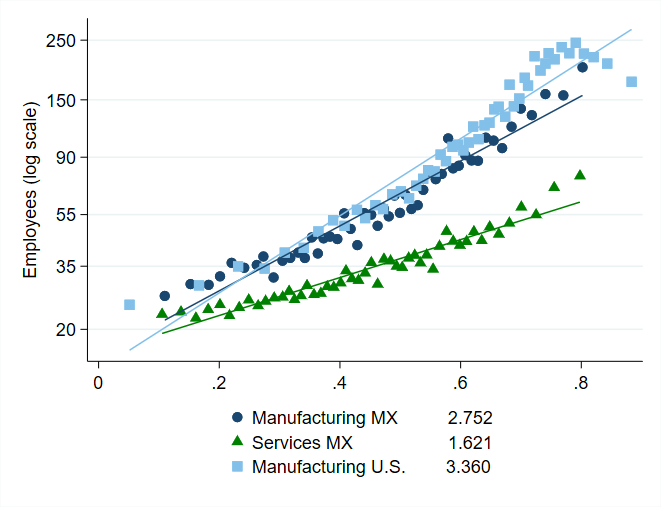
Notes: Bin scatter with 50 quantiles from Mexican and US firm-level management data. Lines are OLS regressions for log(employment) on management scores. 6,643 observations on Mexican manufacturing; 17,684 observations on Mexican services; and 32,000 US manufacturing plants (Bloom et al. 2019) aggregated into 18,000 firms.
This weaker link suggests that the returns to improving management are lower in Mexico. It is not that management does not work; it is that markets do not allow firms to fully reap the benefits. When better management does not reliably translate into expansion and profits, the incentive to invest in it is naturally dampened.
Misallocation as the missing piece
To make sense of this pattern, we embed management into a standard misallocation framework. In an efficient setting, high-productivity firms grow large, while low-productivity firms shrink or exit (Schumpeter 1942, Hsieh and Klenow 2009). In many economies, especially in developing countries, market frictions break this reallocation process. These frictions can come from various sources such as market power, poor contract enforcement, crime and corruption, and distorted access to credit or public support programmes.
In our framework, these distortions act like wedges between productivity and size. They prevent well-managed high-productivity firms from expanding and keep poorly managed firms alive on artificial life support. When we test this model using Mexican data and compare it with the US, we find that managerial scores are not only lower but also more dispersed in Mexico, especially in services, and that this dispersion does not decrease with age as normal selection effects would imply (Figure 3). That is, higher misallocation in Mexico is enough to account for a sizable share of the gap in average management quality.
Figure 3: Age and management score: Spread
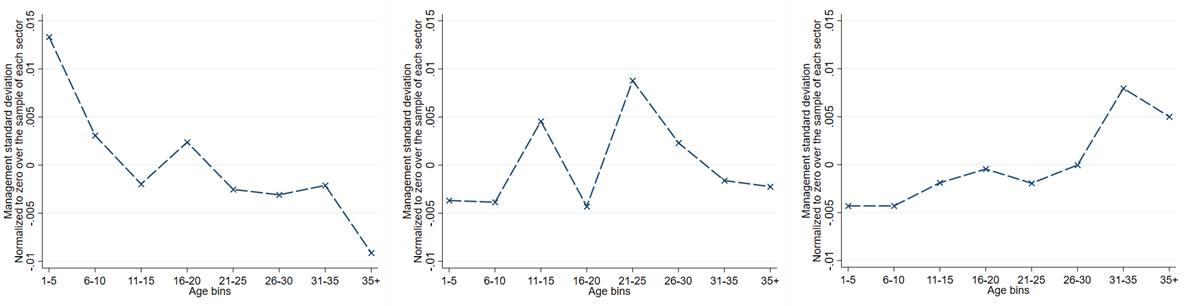
Notes: The mean and variance of management score as a function of firm age. 6,643 observations on Mexican manufacturing; 17,684 observations on Mexican services; and 32,000 US manufacturing plants.
In a more competitive environment, better management should show up as higher jobs and sales growth and stronger chances of survival. Where misallocation is severe, these dynamics are muted. Our evidence for Mexico, where misallocation has been highlighted as a critical barrier to aggregate productivity (Hsieh and Klenow 2014, Misch and Saborowski 2020, Levy 2018), is consistent with this pattern. Good management still helps firms operate more efficiently, but the step from better internal organisation to faster expansion is weakened by external frictions such as contract enforcement and informality (Figure 4).
Figure 4: Sources of misallocation: Institutional strengths
(a) Contract enforcement problems (b) Business informality
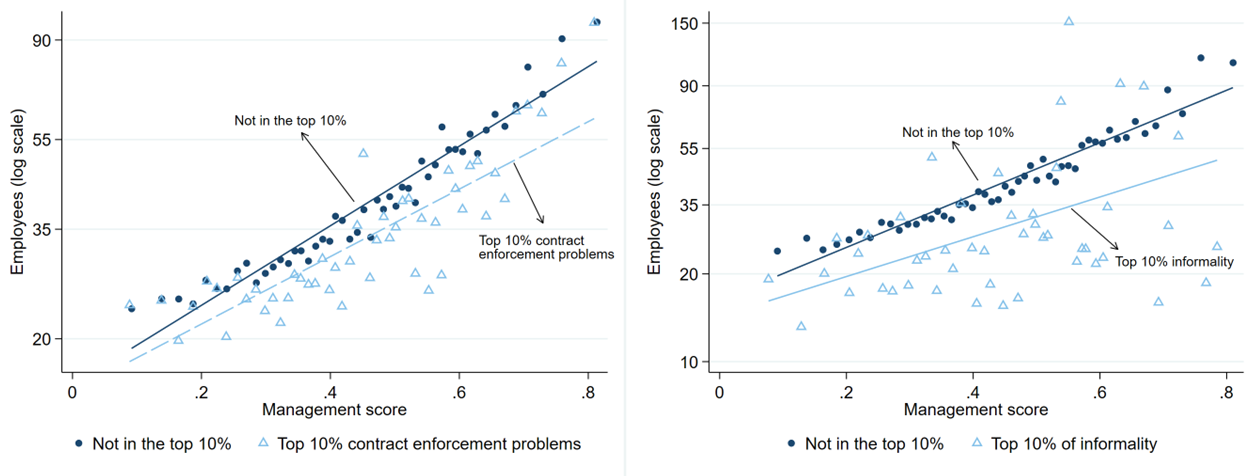
Notes: 6,643 observations on Mexican manufacturing; 17,684 observations on Mexican services.
Put simply, misallocation does two things at once:
- It keeps badly managed firms in business and larger than they would be in an efficient market.
- It shrinks the payoff to become better managed, because the market does not reward improvement with reliable growth.
That combination helps explain why Mexico has many poorly managed firms and why they remain poorly managed.
From Mexico to low-income countries
Mexico is a middle-income country with substantial integration into global markets and fairly sophisticated firms. If misallocation can depress incentives to invest in management here, the problem is likely more acute in low-income settings where legal systems are weaker and contract enforcement is more uncertain; crime, political connections, or regulatory discretion distort who grows; and credit markets and public programmes favour incumbents or politically connected firms.
Many low-income economies have worse misallocation indicators than Mexico. Yet they are often where donors and governments push hardest on management training, entrepreneurship bootcamps, or SME consulting schemes. Our results suggest that these efforts are useful (Bruhn et al. 2018, Scur et al. 2021), but their effectiveness will be limited if the external environment does not reward firms that improve.
In such contexts, a programme that raises average management scores but leaves misallocation untouched will deliver smaller aggregate gains than standard partial-equilibrium thinking would suggest. The same management improvement in a more competitive, less distorted environment would translate into much larger growth and productivity effects.
For policymakers in these contexts, the key message is simple: do not treat management upgrading and business environment reform as separate agendas. They are tightly linked.
Linking internal and external levers of productivity
One can distinguish between factors inside the firm, i.e. management practices, worker skills, technology, and factors outside the firm, i.e. competition, institutions, regulation, misallocation (Syverson 2011). Our work pushes that distinction one step further. The internal and external levers are not independent. The external environment shapes the return to internal improvement.
When markets are open and contestable, and institutions protect contracts, better management is strongly rewarded. High-productivity firms grow rapidly and pull resources away from laggards. When markets are distorted and institutions are weak, the same management improvements produce smaller gains in scale and profit. High-productivity firms struggle to expand, and low-productivity firms persist. This interaction helps explain why similar management interventions can have very different impacts across countries, sectors, or regions. The same consulting programme that dramatically raises profits in one context might look disappointing in another, not because the content is different, but because the external incentives are weaker.
Policy implications: Making management worth the effort
For governments, donors, and international organisations, three lessons follow.
- Management upgrading still matters. The evidence from Mexico confirms that structured management practices are strongly associated with better firm performance. This supports continued investment in targeted management support programmes, especially those that combine consulting with peer learning and follow-up (Iacovone et al. 2022).
- Do not expect management programmes to carry the full burden of productivity growth. Where misallocation is severe, the same improvement in management quality delivers smaller aggregate gains. There is a real risk of overpromising based on evidence from contexts with stronger selection and reallocation.
- Raise the returns to good management by improving the business environment. In practice, this means opening markets to entry and competition, including in non-tradable services, strengthening contract enforcement, speeding up courts, and reducing regulatory discretion, tackling crime, extortion, and corruption that distort which firms can grow, and ensuring that credit and subsidy programmes do not prop up unproductive incumbents at the expense of dynamic, better-managed firms.
Only when well-managed firms can reliably grow, gain market share, and earn higher profits will managers across the distribution see improving their organisation as a worthwhile investment.
Beyond Mexico: A broader research and policy agenda
The Mexican case gives a clear message for many other developing economies. Management is not just an internal ‘best practice’ problem, and misallocation is not just a macro distortion in the background. They are two sides of the same coin. For researchers, the next step is to bring this interaction between internal and external drivers of productivity into more empirical work and policy evaluation. For policymakers, the challenge is to design packages that combine management upgrading with reforms that make good management pay.
References
Bloom, N, B Eifert, A Mahajan, D McKenzie, and J Roberts (2013), “Does management matter? Evidence from India,” Quarterly Journal of Economics, 128: 1–51.
Bloom, N, E Brynjolfsson, L Foster, R Jarmin, M Patnaik, I Saporta-Eksten, and J Van Reenen (2019), “What drives differences in management practices?” American Economic Review, 109: 1648–1683.
Bloom, N, L Iacovone, M Pereira-Lopez, and J Van Reenen (forthcoming), “Management and misallocation in Mexico,” American Economic Journal: Macroeconomics.
Bruhn, M, D Karlan, and A Schoar (2018), “The impact of consulting services on small and medium enterprises: Evidence from a randomized trial in Mexico,” Journal of Political Economy, 126: 635–687.
Hsieh, C-T, and P J Klenow (2009), “Misallocation and manufacturing TFP in China and India,” Quarterly Journal of Economics, 124: 1403–1448.
Hsieh, C-T, and P J Klenow (2014), “The life cycle of plants in India and Mexico,” Quarterly Journal of Economics, 129: 1035–1084.
Iacovone, L, W Maloney, and D McKenzie (2022), “Improving management with individual and group-based consulting: Results from a randomized experiment in Colombia,” Review of Economic Studies, 89: 346–371.
Levy, S (2018), "Under-rewarded efforts: The elusive quest for prosperity in Mexico," Inter-American Development Bank.
Misch, F, and C Saborowski (2020), “The drivers and consequences of resource misallocation: Exploiting variation across Mexican industries and states,” Economía, 20: 61–96.
Schumpeter, J (1942), Capitalism, socialism and democracy, Harper & Bros, New York.
Scur, D, R Sadun, J Van Reenen, R Lemos, and N Bloom (2021), “The World Management Survey at 18: Lessons and the way forward,” Oxford Review of Economic Policy, 37: 231–258.
Scur, D, et al. (2024), “The international empirics of management,” Proceedings of the National Academy of Sciences, 121(45).
Syverson, C (2011), “What determines productivity?” Journal of Economic Literature, 49: 326–365.
Van Reenen, J (2019), “Can managers boost development?” VoxDev.