




In Mexico, violence against journalists reduces media activity in the months following an attack and, in the long run, reshapes the profession towards younger and less-established reporters – with lasting implications for local government transparency and electoral outcomes.
In his last column for The Washington Post in October 2017, journalist Jamal Khashoggi argued that a lack of press freedom leads people to be “uninformed or misinformed” and “unable to adequately address, much less publicly discuss, matters that affect their day-to-day lives”. He advocated for press freedom as a key instrument to help ordinary citizens address the problems their societies faced.
Many scholars have also underscored the role that news outlets play in enabling citizens to hold politicians, corporations, and other influential actors accountable. Media reporting is crucial in shaping electoral outcomes and exposing corruption (Ferraz and Finan 2008, Strömberg 2015, Larreguy et al. 2020). But journalists’ capacity to fulfil this role depends on their ability to conduct their work free of violence and threats.
Khashoggi’s last column was published almost two weeks after he had been killed at the Saudi consulate in Istanbul, a stark end to his advocacy for media freedom in the Arab world. Beyond this particular case, the killings of media workers are unfortunately a recurring phenomenon. In 2025, 130 journalists or media workers were killed around the world (CPJ 2025), a phenomenon that is widespread and not confined to authoritarian countries (Carey and Gohdes 2021).
In recent research (Jurado and Morales 2026), we study the effects of journalists’ killings on media activity. We investigate the case of Mexico, one of the most dangerous countries for media workers, where cartels and criminal organisations often target those who report on topics of crime, politics, or corruption.
Previous work suggests that targeted violence against journalists in Mexico may have ambiguous effects. A journalist working along the US border reported:
“We still haven’t shaken the fear that we had at one point, that’s to say there are many things that could be investigated but that aren’t” (Relly and González de Bustamante 2014).
On the other hand, threats and acts of violence may induce a backlash among journalists, as suggested by another reporter:
“If they call us to tell us what to do, or what not to publish, we’re going to publish it twice over and we’re also going to write that they called us to tell us not to do it” (Relly and González de Bustamante 2014).
Our empirical work, centred on the 45 journalists killed between 2010 and 2020 across Mexico (Figure 1), aims to better understand the effects of violence against journalists.
Figure 1: Spatial and temporal distribution of journalists’ killings in our sample
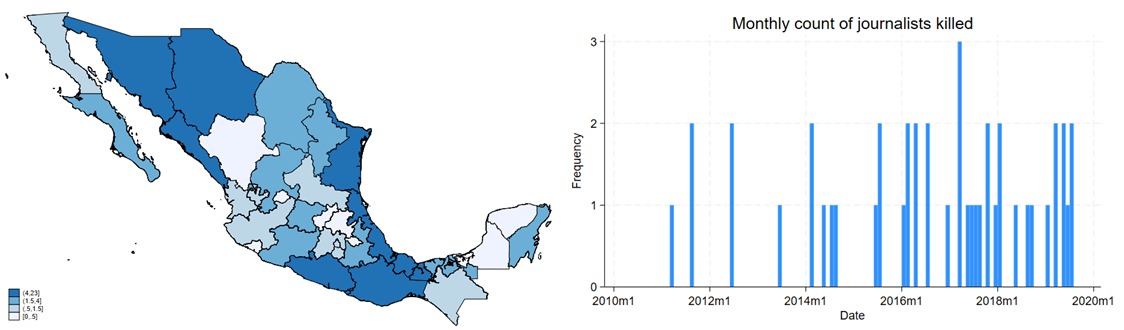
Note: Panel A shows where killings occurred. Panel B shows the dates on which they took place.
Days after a killing
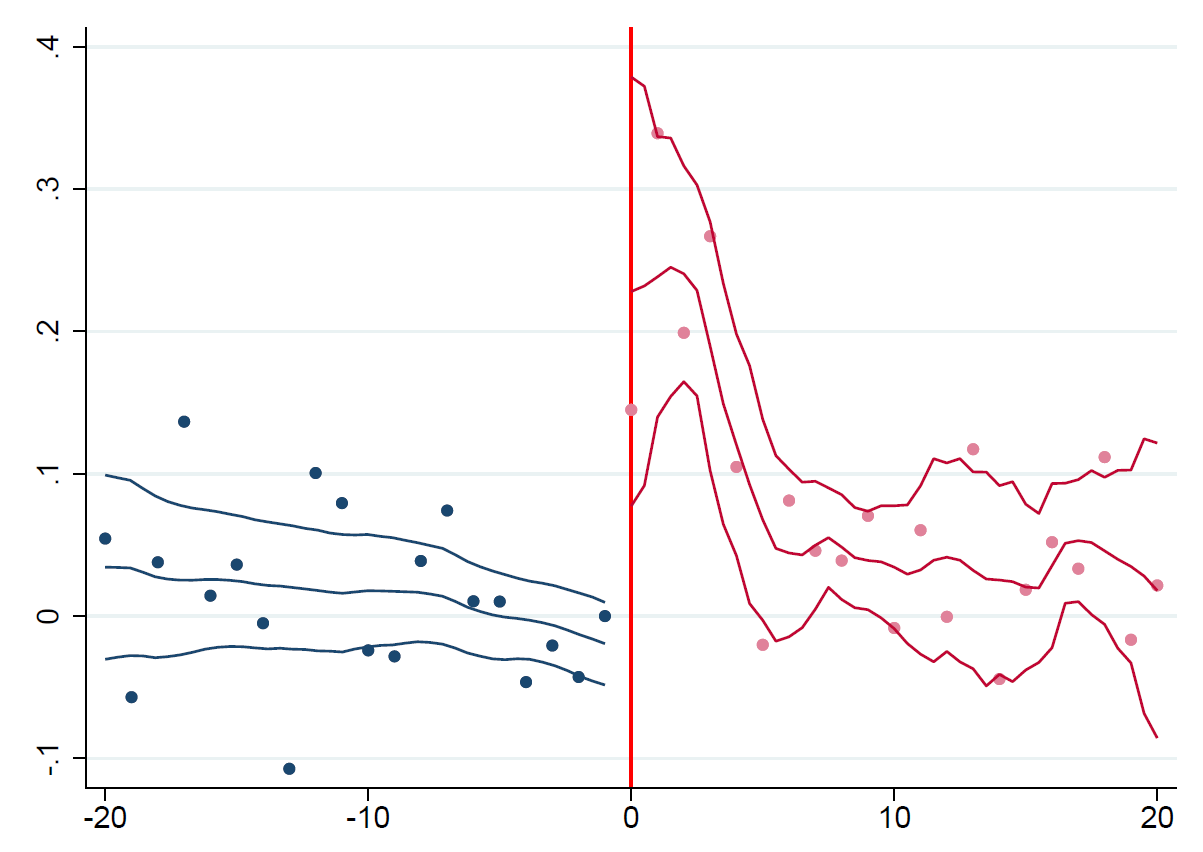
The murders of journalists do not go unnoticed. Other media outlets and non-profit organisations often report on them, with Google Trends data confirming that searches for the keyword periodista (journalist) spike in the days following each killing. This finding suggests that the public recognises the gravity of these attacks.
Figure 2: Google Trends searches for journalist relative to day of killings
Months after a killing
To understand the extent to which violence against journalists represses reporting, we compiled a new dataset of online media activity based on Twitter posts published by Mexican news media outlets. Twitter activity has been shown to correlate with traditional media activity and is used widely by news outlets to disseminate their coverage (Cagé et al. 2020). We combine this dataset with the records of reported killings, allowing us to link violent events to observed media activity.
We use (heterogeneity-robust) event studies to compare online media activity of affected outlets – those the assassinated journalists were affiliated with – relative to activity of outlets not yet affected, in the months before and after each killing. Our analysis reveals a sharp decline in the number of posts in the months after the killings (Figure 3). We document an average reduction of 0.38 log points in the number of posts (or about 240 fewer monthly posts from a mean of roughly 850) in the 10-month period after the killings.
Figure 3: Event-study analyses of the effect of journalists’ killings on online media activity
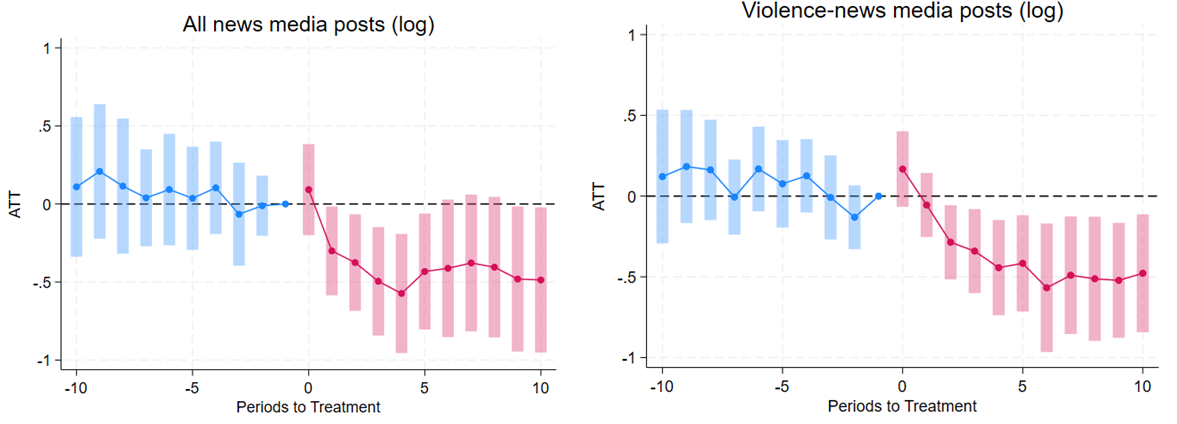
Importantly, the decline in activity affects all topics, not only news posts related to violence or crime. Furthermore, we observe an increase in the number of grammatical errors in the posts in the months after the attacks. However, the effects tend to dissipate 10 to 20 months after the killings. Taken together, these patterns provide further evidence of the disruptive nature of these targeted attacks.
Years after a killing
We investigate the wider repercussions of this targeted violence using data from the 2010 and 2015 Mexican censuses. In long-run difference-in-differences and triple-difference models, we analyse the relationship between the number of journalists killed – at both the state and municipal level – and the size and composition of the profession. We find that, relative to similar occupations, the share of respondents who work as journalists decreases markedly in violent locations. Furthermore, the demographic characteristics of those who remain in the profession shift: journalists working in violent areas tend to be younger, less likely to be married, and less likely to have children.
Finally, we document broader governance implications. Using annual data from a standardised measure of municipal transparency, based on the quality and completeness of published budget documents, we show that journalist killings are associated with declines in transparency scores. We also find that these killings are associated with a modest electoral advantage for the PRI, a party historically linked to higher levels of corruption. Together, these results suggest that violence against the press weakens government accountability and affects the quality of democratic outcomes at the local level.
Implications for freedom of the press
Our findings highlight two channels through which violence against journalists undermines accountability. In the months following the events, journalist killings disrupt media organisations and restrict the flow of information, as affected outlets sharply reduce their output. In the longer run, violence reshapes who enters and who remains in the profession, potentially leading to a deprofessionalisation of the media and a deterioration in the quality of reporting.
Tragically, attacks on media workers persist today. Since the beginning of 2026, 18 journalists have been killed, predominantly in conflict zones such as Lebanon and Gaza (CPJ 2026). In times of conflict, precisely when the stakes of public decisions are highest and the risk of abuse greatest, an independent press, free of violence, is most needed.
References
Cagé, J, N Hervé, and M L Viaud (2020), “The production of information in an online world”, The Review of Economic Studies 87(5): 2126–2164.
Carey, S C, and A R Gohdes (2021), “Understanding journalist killings”, The Journal of Politics 83(4): 1216–1228.
Committee to Protect Journalists (CPJ) (2025), “130 journalists and media workers killed”.
Committee to Protect Journalists (CPJ) (2026), “18 journalists and media workers killed”.
Ferraz, C, and F Finan (2008), “Exposing corrupt politicians: The effects of Brazil's publicly released audits on electoral outcomes”, The Quarterly Journal of Economics 123(2): 703–745.
Jurado, J A, and J S Morales (2026), “Violence against journalists and freedom of the press: Evidence from Mexico”, Journal of Development Economics, 103775.
Larreguy, H, J Marshall, and J M Snyder Jr (2020), “Publicising malfeasance: When the local media structure facilitates electoral accountability in Mexico”, The Economic Journal 130(631): 2291–2327.
Relly, J E, and C González de Bustamante (2014), “Silencing Mexico: A study of influences on journalists in the Northern states”, The International Journal of Press/Politics 19(1): 108–131.
Strömberg, D (2015), “Media and politics”, Annual Review of Economics 7(1): 173–205.