





Rising homicide rates in Mexico have left aggregate employment largely unchanged – but beneath this apparent stability, violence is reshaping who works and where, holding back the labour market and undermining productivity.
Editor’s note: For a broader synthesis of themes covered in this article, check out our VoxDevLit on Organised Crime.
Crime imposes large economic costs, affecting investment, firm behaviour, and household decisions (Tobón et al. 2025). In Mexico, homicide rates have risen sharply since 2007, driven by escalating conflicts among drug-trafficking organisations. By 2018, the national homicide rate had more than tripled relative to a decade earlier, imposing substantial costs on households and firms. Yet over the same period, employment has continued to expand, and we find little evidence that rising homicide rates reduce employment at the local level.
How can we reconcile this apparent contradiction? In recent work (Aldeco Leo, Ghilardi, and Tuesta 2026), we show that aggregate stability masks a deeper story: violence reshapes the composition of the workforce in ways that do not appear in headline statistics but induce misallocation of labour. This pattern is consistent with a broader evidence base showing that misallocation is a key driver of development outcomes (Hsieh and Klenow 2009) and that crime can exacerbate these distortions (Misch and Saborowski 2020, Bisca et al. 2024). Understanding these mechanisms – and who bears the burden – is essential for interpreting labour market dynamics and designing effective policy responses.
Table 1: Homicide rate (100,000 inhabitants per population)
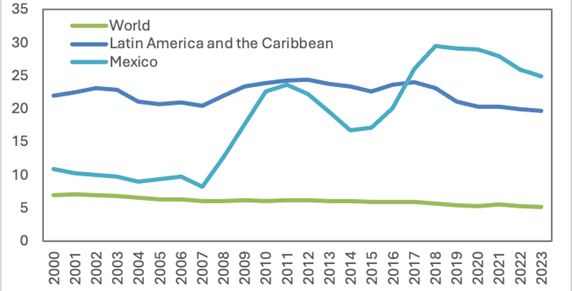
Sources: UN and Our World in Data.
Understanding the labour market consequences of homicides
Our analysis draws on Mexico's ENOE, a nationally representative rotating household panel survey covering over 16 million individual-quarter observations from 2005 to 2019. This dataset allows us to follow individuals over time and examine how short-run changes in local homicide rates affect labour force participation, employment, informality, and job separations, while accounting for individual characteristics and broader economic conditions.
A key feature of our approach is that we compare the same individuals at different points in time, as local homicide rates change. This helps account for unobserved differences across workers, such as skills or work preferences. We also distinguish between areas with and without significant cartel presence, using detailed data on cartel activity at the municipal level.
Stable total employment, hidden reshuffling
When violence rises in a municipality, our results show that aggregate employment barely changes. However, looking separately by gender reveals a clear recomposition of the workforce as homicides increase. Men are more likely to exit the labour market in high-violence areas, while female participation rises by a similar magnitude, primarily through entry into informal employment. We provide direct household-level evidence of this pattern, showing that higher homicide rates significantly increase the likelihood of observing male exits and female entries within the same household in the same quarter.
This opposite-direction response reflects a well-known economic mechanism: the added-worker effect. When a primary earner withdraws from the labour market, other household members step in to compensate for lost income. In Mexico, that primary earner is typically male, and the adjustment takes the form of women entering the labour force. However, this does not reflect improved economic opportunity. Women who enter the workforce in response to violence do so mainly through informal jobs, which lack social security, formal contracts, and worker protections. These jobs typically have low productivity, so this reshuffling reflects a decline in the overall efficiency of labour allocation.
Table 2: Impact of homicides on labour force participation
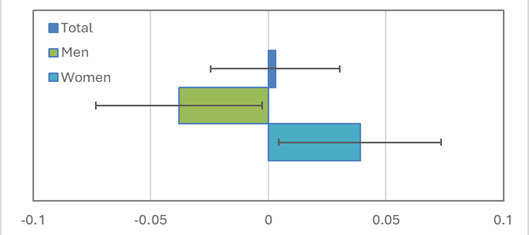
Note: Results are statistically significant at the 5 percent level (p<0.05) for men, while results for women reach statistical significance at the 10 percent level (p<0.10). Source: Aldeco et al. (2026).
The role of drug-trafficking organisations
The gender reversal we document differs from patterns found in other countries, such as India, where women tend to withdraw from the labour market when crime rises (Mishra et al. 2021). This reflects the nature of violence in Mexico. Drug-trafficking organisations are a key driver of homicides and disproportionately employ and target men. Where cartel presence is highest, the gender asymmetry in labour force responses becomes much more pronounced. In areas without significant organised crime activity, there is little evidence of either effect. While the specifics differ across settings, this pattern is consistent with a broader evidence base showing that organised crime harms economic activity by distorting decisions and shifting resources away from their most productive uses (Bisca et al. 2024, Tobón et al. 2025).
Violence also destabilises existing employment
Beyond participation, rising homicide rates also lead to reshuffling among employed workers by increasing the likelihood of job separations. As violence rises, workers become more likely to leave their jobs, with women responding more strongly than men. These separations are concentrated in specific sectors. We find that workers, particularly women, move toward service-sector jobs following increases in violence. Men are more likely to leave retail positions and move into services as well. This movement of workers across firms and sectors, even when aggregate employment remains stable, provides further evidence of labour market misallocation: workers move into jobs that may not match their skills or experience, disrupting careers and eroding human capital over time.
Implications for policy
A broad lesson is that the economic costs of violence extend beyond what standard indicators capture. In Mexico, rising homicides do not lead to large declines in employment, but instead trigger a reallocation of labour across workers, sectors, and types of jobs. Understanding these hidden adjustments is essential. Without it, policymakers risk overlooking the gradual erosion of job quality, productivity, and household welfare that violence can bring.
These findings also underscore the need to examine gender-specific impacts of crime on labour markets. Policies to curb crime should not only focus on enhancing public safety but also on ways to mitigate economic disruptions that affect men and women in different ways. By understanding these gendered responses, more targeted and effective policies can be developed to stabilise labour markets and support household incomes in the face of rising crime.
Authors' note: The views expressed herein are those of the authors and should not be attributed to the IMF, its Executive Board, or its management.
References
Aldeco Leo, L, M F Ghilardi, and H Tuesta (2026), "Labor market consequences of homicides: A gender perspective from Mexico," Journal of Development Economics, 180: 103718.
Bisca, P M, V Chau, P Dudine, R A Espinoza, J-M Fournier, P Guérin, N-J H Hansen, and J Salas (2024), "Violent crime and insecurity in Latin America and the Caribbean: A macroeconomic perspective," Unpublished manuscript.
Hsieh, C-T, and P J Klenow (2009), "Misallocation and manufacturing TFP in China and India," Quarterly Journal of Economics, 124(4): 1403–1448.
Misch, F, and C Saborowski (2020), "The drivers and consequences of resource misallocation: Exploiting variation across Mexican industries and states," Economía, 20(2): 61–96.
Mishra, A, V Mishra, and J Parasnis (2021), "The asymmetric role of crime in women's and men's labour force participation: Evidence from India," Journal of Economic Behavior and Organization, 188: 933–961.
Tobón, S, M M Sviatschi, and N Cabra-Ruiz (2025), "Organised crime," VoxDevLit, 17(1).