





A school-based career exploration programme in India raised female students’ aspirations and confidence by improving access to information and role models, but persistent structural constraints prevented these gains from translating into medium-term behavioural change.
Low female labour force participation remains one of the most persistent development challenges in India (Afridi 2025). Even among young women who complete secondary education, large shares do not continue their formal skill formation and never enter paid work (Klasen 2019, NSSO 2023). At the same time, a substantial share of women report that they would like to work for pay but aspire to occupations for which they never obtained formal qualifications (Fletcher et al. 2017). Incomplete information about career paths, a lack of professional role models, and restrictive gender norms are likely contributors to these suboptimal career choices and low rates of female labour force participation (Heath et al. 2025, Jayachandran 2020, Jensen 2010, Kipchumba et al. 2024).
Career-focused programmes implemented in schools could provide a low-cost way to support young people during this critical transition. By encouraging students to reflect on their interests and plan future pathways, such programmes may promote more informed and interest-based career choices (Renée 2025, Resnjanskij et al. 2024). Yet, evidence from developing countries is limited (Gehrke et al. 2023, Kipchumba et al. 2024, Loyalka et al. 2013), and a crucial question remains: can a programme that supports students in exploring career pathways alter their aspirations and actions?
A scalable school-based intervention in urban India
Our recent research (Asri, Asri, and Hoeffler 2026) sheds light on this question by evaluating a school-based career exploration programme, designed and implemented by Alohomora Education Foundation, a local NGO in urban India. The programme engaged primarily female students in their final year of secondary school from low-income households. Most had never received any formal career guidance and reported that no woman at home had been working for the last two years.
The intervention is intensive yet low-cost and scalable. Delivered during school hours, the ten-hour programme consisted of 15 interactive sessions in which relatable facilitators guided students to (i) reflect on their interests and strengths, (ii) explore a broader range of career options accessible to them, and (iii) develop a concrete plan of action for pursuing their preferred career after finishing school.
Rather than advising students to pursue specific careers, facilitators acted as near-peer role models, guiding students through their structured reflections and planning: an approach shown in other contexts to be particularly effective for adolescents (Bettinger and Evans 2019).
Evaluating a school-level career exploration programme
We evaluate the career exploration programme using a pre-registered, school-level randomised controlled trial involving over 6,000 students in 45 non-fee-paying secondary schools in collaboration with Inclusion Economics India Centre. Short-term outcomes were measured using self-administered tablet-based surveys conducted in classrooms immediately after programme completion, approximately five to six months before students finished school. Medium-term outcomes were captured through follow-up phone surveys administered around six months after students had completed secondary education.
Short-term outcomes focus primarily on students’ career aspirations and planning, while medium-term outcomes measure realised post-school behaviour. In addition to the impact on students in the treatment group (Intention-To-Treat), facilitators recorded the attendance for each student, allowing us to estimate the impact on regularly participating students (Local Average Treatment Effect).
What career exploration changed: Planning and aspirations
The programme had positive short-term impacts on students’ aspirations and planning, consistent with evidence that interventions targeting information and aspirations can meaningfully shift young people’s expectations and plans (Bettinger and Evans 2019). Treatment group students were more likely to…
- Plan to take an entrance exam (57% control group, 61% treatment group, 65% regularly participating)
- Consider interests as the most important factor in choosing a career (44% control, 51% treatment, 59% regular)
- Believe in intergenerational mobility (53% control, 57% treatment, 60% regular)
Additionally, we find that treatment group students were more likely to…
- Think about the future (89% control, 92% treatment, 95% regular)
- Know their preferred occupation (74% control, 80% treatment, 87% regular)
- Feel confident about achieving their career objective (73% control, 79% treatment, 86% regular)
- Discuss their plans with their parents (65% control, 69% treatment, 72% regular)
These impacts were visible for all students in the treatment group but doubled in size for those students who participated more regularly (10 or more sessions). Attendance, in turn, depended not only on individual engagement but also on school-level support, highlighting the importance of institutional buy-in for programme effectiveness.
Figure 1: Short-term impacts of Career Exploration Programme
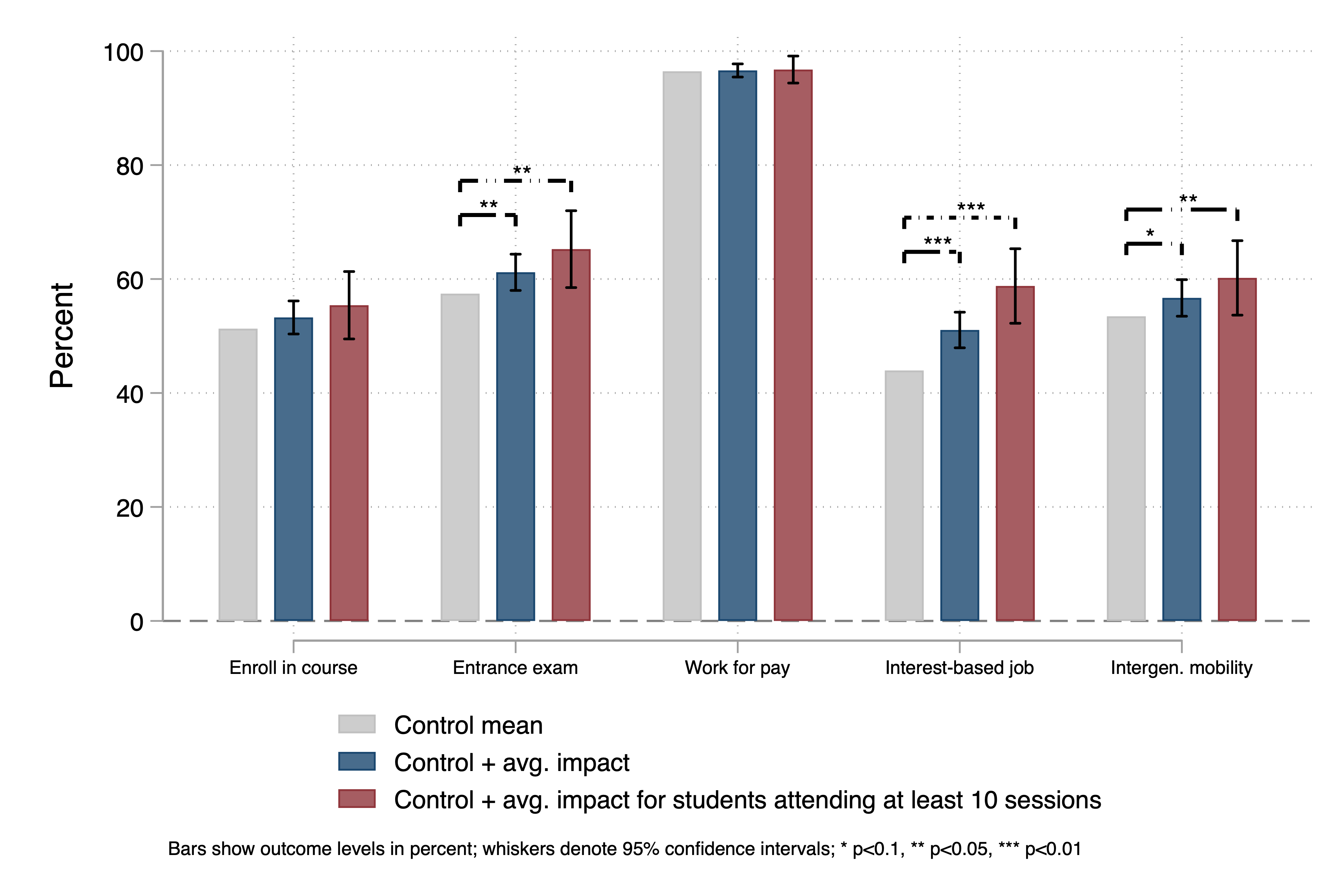
Figure 2: Additional impacts of Career Exploration Programme
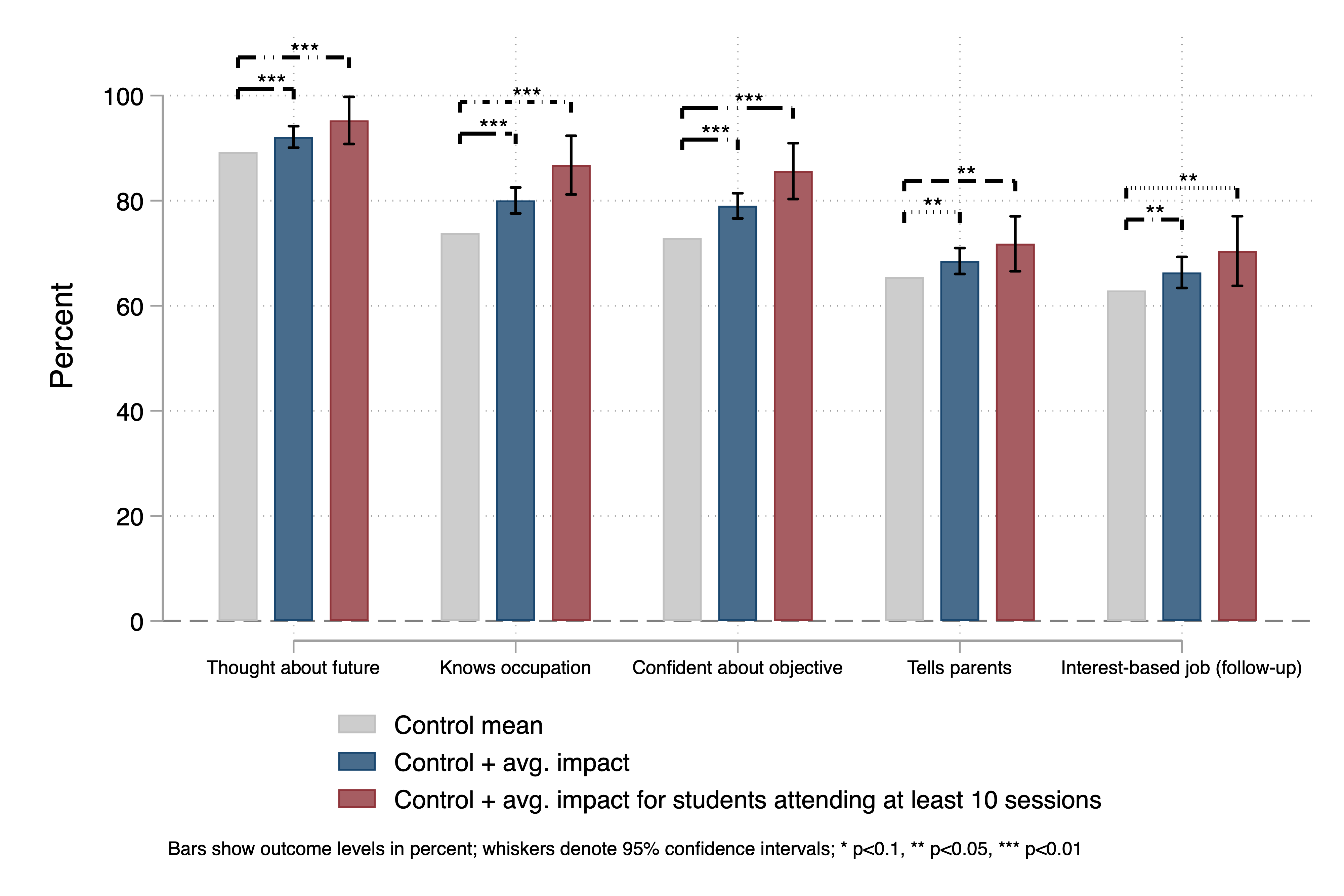
The programme altered how students viewed careers. Rather than limiting themselves to a narrow set of socially respected occupations, students increasingly took their own interests into account when choosing a career path.
What the programme did not change in the medium-term: Career-related behaviour after school
Six months after leaving school (or around one year after programme implementation), we find that students continue to prioritise their interests when selecting a career path. Yet, despite these positive impacts on aspirations and planning, we find no evidence of medium-term behavioural effects on our pre-registered outcomes.
Students in the treatment group were no more likely to be enrolled in further education or training, have taken the entrance exam, or be working for pay.
Figure 3: Medium-term impacts of Career Exploration Programme
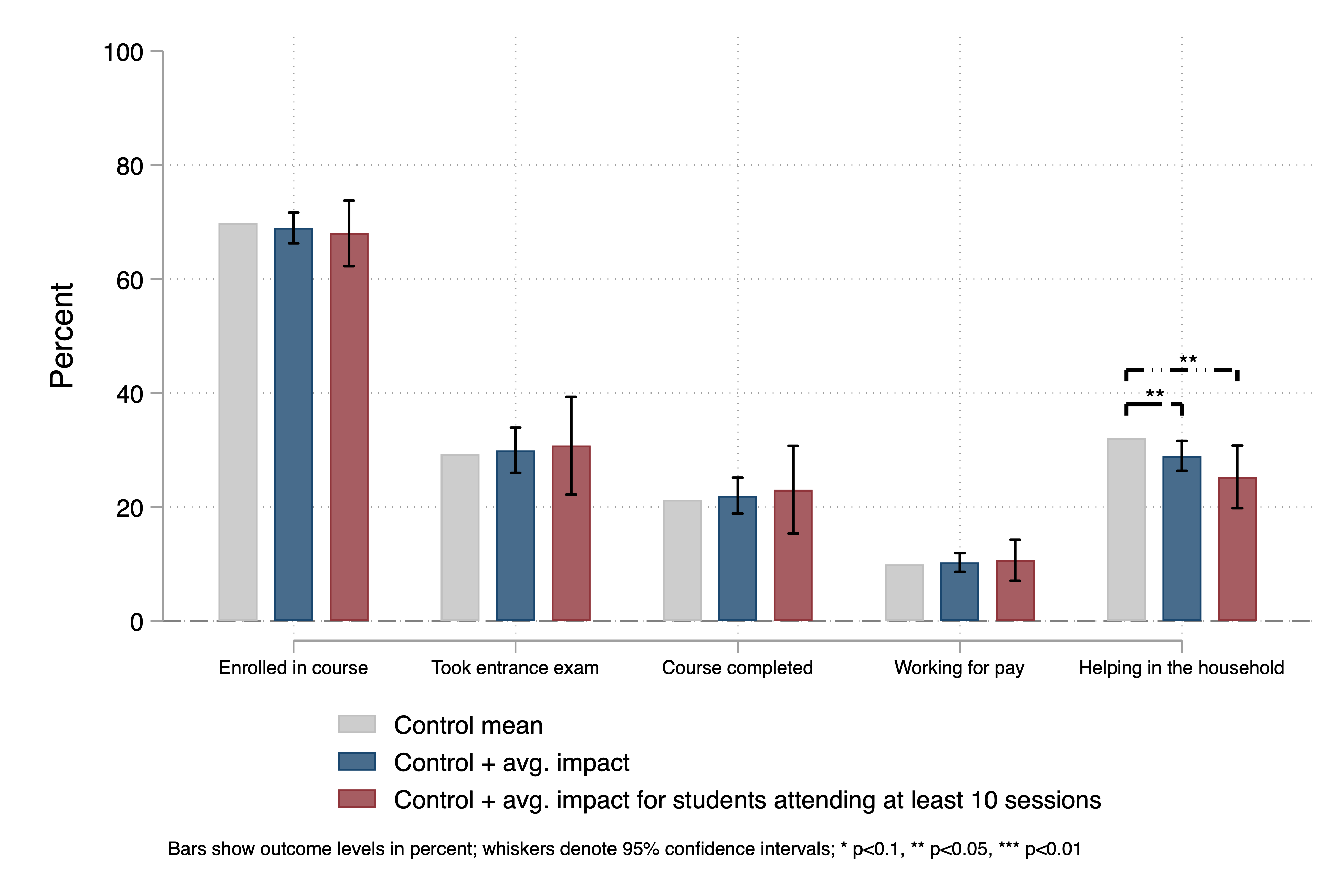
Yet, while not pre-registered, we find that female students in the treatment group were less likely to report helping in the household. This suggests that treatment students are more time-constrained than control group students even if their current enrolment status is not significantly different. While this could signal that students spend more time studying or are simply better at protecting their time by limiting their domestic responsibilities, this requires further examination.
How did change occur?
The career exploration programme has the potential to impact students through various mechanisms, and our pre-registered analysis enables us to shed light on how and why these impacts occurred. We expected the following mechanisms to play a role in explaining some of the variation in the observed impacts:
- Providing access to information on many different careers
- Generating peer effects by encouraging students to discuss their career plans
- Encouraging students to seek family or community support
- Students seeing facilitators as role models and inspiring sources of information
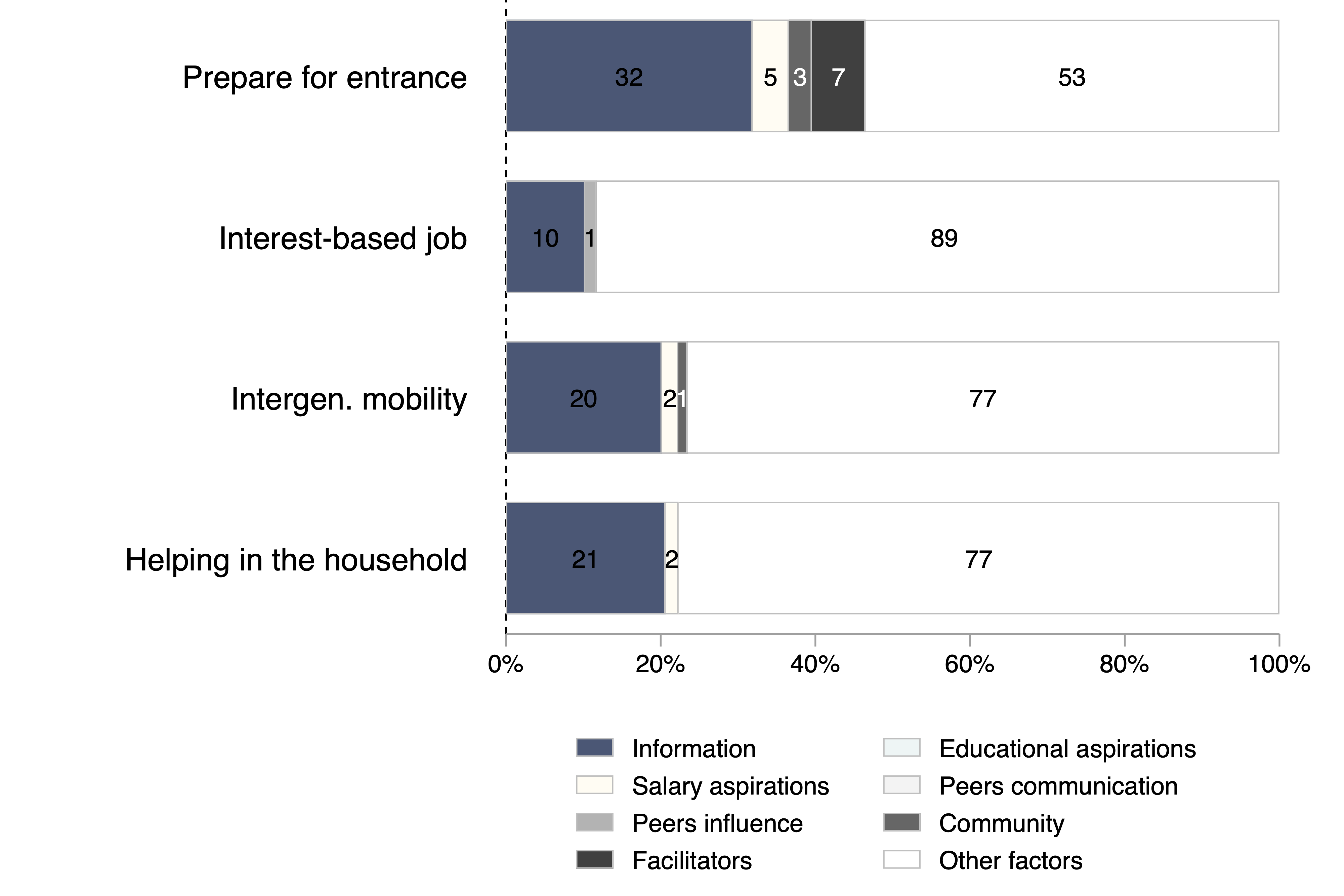
We find that among the expected channels, providing information is clearly the most important one, explaining 10–32% of the variation in the observed impacts. This is followed by the role of near-peer facilitators acting as role models, explaining 7% of the impact on planning to prepare for an entrance exam. Other hypothesised mechanisms appear to play a minor role, but their contribution varies with the outcome, with 53–89% of the variation in the observed impacts remaining unexplained.
Figure 4: Effects explained by mediators
Why did aspirations not translate into action?
Our results suggest that structural constraints persist, even as aspirations increase and planning improves. Such structural constraints likely include financial constraints, parental expectations, gender norms, and institutional frictions.
- Financial constraints remain severe. While most courses in tertiary education have low fees, commuting on a daily basis can be a significant financial burden. Male students may also face pressure to contribute to household income, which can limit their ability to pursue further education or training.
- Parental expectations and gender norms continue to shape choices. While students improved their planning for the future and are more likely to communicate their plans to parents, this does not guarantee parental support, especially for non-traditional and unexpected pathways for young women.
- Institutional frictions. Accessing tertiary education in India often requires navigating complex entrance exams and administrative procedures, which may require more sustained support than the career exploration programme can provide.
- Career plans and decisions unfold over time. The absence of medium-term effects does not necessarily imply that the programme had no lasting influence, but rather that changing aspirations may be insufficient when opportunities remain constrained. A future survey of the students will further examine this.
Lessons for policy: Career exploration is not enough on its own
Low-cost career guidance programmes can enhance aspirations, confidence, and planning skills among disadvantaged students. These are important outcomes as they shape how young people engage with future opportunities. Yet, aspirations are not self-fulfilling. Without complementary policies addressing financial, institutional, and social constraints, improved aspirations may not translate into action.
Timing and integration matter. Career exploration might be more effective when combined with financial aid, continued mentoring beyond school, or parental engagement. Our results suggest that career guidance programmes should be integrated into broader strategies designed to support school-to-work transitions.
These programmes hold promise, but also have clear limits. Our findings demonstrate that such interventions can influence the way young women perceive their futures, even in settings characterised by rigid gender norms. At the same time, they highlight the difficulty of converting aspirations into action when structural barriers remain in place.
References
Afridi, F (2025), “Markets, marriage, and norms: Understanding female labour force participation in India,” VoxDev.
Asri, A, V Asri, and A Hoeffler (2026), “Unlocking young women’s potential? The impact of a low-cost career guidance program,” Journal of Development Economics, 179: 103662.
Bettinger, E P, and B J Evans (2019), “College guidance for all: A randomized experiment in pre-college advising,” Journal of Policy Analysis and Management, 38: 579–599.
Fletcher, E, R Pande, and C M T Moore (2017), “Women and work in India: Descriptive evidence and a review of potential policies,” Unpublished manuscript.
Gehrke, E, F Lenel, and C Schupp (2023), “Occupational aspirations and investments in education: Experimental evidence from Cambodia,” Unpublished manuscript.
Heath, R, A Bernhardt, G Borker, A Fitzpatrick, A Keats, M McKelway, A Menzel, T Molina, and G Sharma (2025), “Female labour force participation,” VoxDevLit, 11(2).
Jayachandran, S (2020), “Social norms as a barrier to women’s employment in developing countries,” Unpublished manuscript.
Jensen, R (2010), “The (perceived) returns to education and the demand for schooling,” Quarterly Journal of Economics, 125: 515–548.
Kipchumba, E, C Porter, D Serra, and M Sulaiman (2024), “The impact of role models on youths’ aspirations, gender attitudes, and education in Somalia,” Unpublished manuscript.
Klasen, S (2019), “What explains uneven female labor force participation levels and trends in developing countries?” World Bank Research Observer, 34: 161–197.
Loyalka, P, C Liu, Y Song, H Yi, X Huang, J Wei, L Zhang, Y Shi, J Chu, and S Rozelle (2013), “Can information and counseling help students from poor rural areas go to high school? Evidence from China,” Journal of Comparative Economics, 41: 1012–1025.
National Sample Survey Office (NSSO) (2023), "Annual report: Periodic Labour Force Survey (PLFS), July 2022–June 2023."
Renée, L (2025), “The long-term effects of career guidance in high school and student financial aid: Evidence from a randomized experiment,” American Economic Journal: Applied Economics, 17: 165–183.
Resnjanskij, S, J Ruhose, S Wiederhold, L Woessmann, and K Wedel (2024), “Can mentoring alleviate family disadvantage in adolescence? A field experiment to improve labor market prospects,” Journal of Political Economy, 132: 1013–1062.