





A government-led, state-wide programme in India (the SHE Pad Scheme) which provided free sanitary pads in schools significantly reduced dropout rates among adolescent girls, primarily by increasing school attendance.
Globally, an estimated 500 million women and girls experience period poverty – the lack of access to menstrual products and safe sanitation facilities for menstrual hygiene management (World Bank 2018, Castro and Czura 2025). The consequences of period poverty extend far beyond immediate health concerns; it undermines educational attainment, restricts social mobility, and exacerbates existing economic and gender disparities (Dasra 2015, UNESCO 2014).
For millions of girls, menstruation results in social withdrawal, confinement to the home, and frequent school absenteeism – consequences driven solely by inadequate access to basic menstrual hygiene products. These challenges are compounded by pervasive socio-cultural stigmas and entrenched discriminatory norms that portray menstruation as impure or shameful.
Given the recurring nature of menstruation, insufficient access to menstrual hygiene products leads to repeated and cumulative educational disruptions. Over time, these disruptions significantly impair academic performance and increase the likelihood of school dropout. Recognising these challenges, several programmes have provided short-term distribution of sanitary products to school-aged girls (Montgomery et al. 2012, Montgomery et al. 2016, Oster and Thornton 2011, Phillips-Howard et al. 2016). However, such interventions are often temporary and limited in scale. Addressing period poverty effectively requires more than ad hoc solutions; it necessitates sustained investment in long-term, scalable programmes that provide continuous support from menarche. Yet empirical evidence on the effectiveness of such interventions remains limited.
Studying the impact of distributing free sanitary pads in schools
In Agarwal, Chia, and Ghosh (2024), we evaluate the SHE Pad Scheme, a large-scale, government-initiated programme in Kerala, India, that provides free sanitary pads to all menstruating schoolgirls. Leveraging rich administrative data, we examine the programme’s effects on key educational outcomes – including dropout rates and attendance – for girls aged 10 to 16.
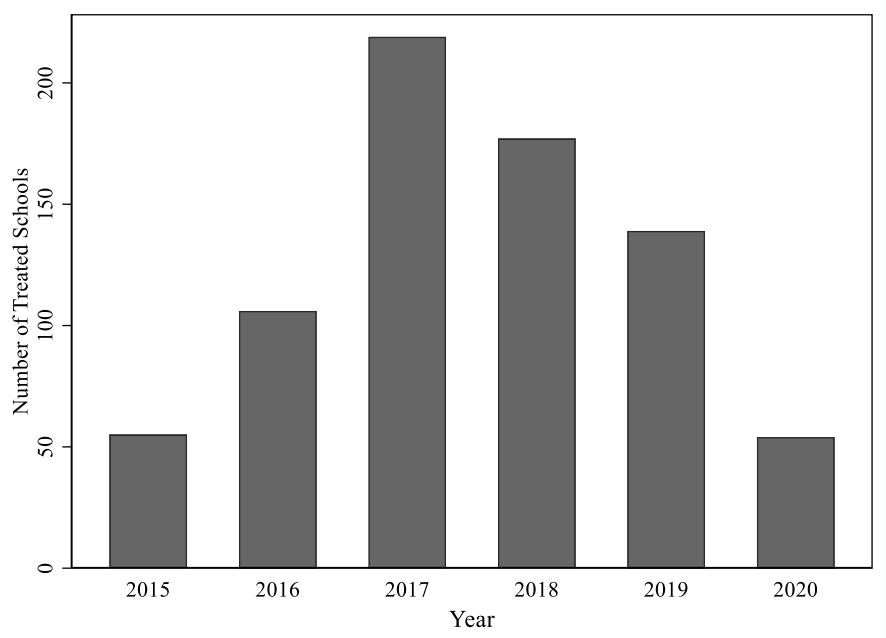
The programme was implemented state-wide in 2017 following pilot trials in 2015. It involved the installation of sanitary pad vending machines and incinerators in schools offering upper primary, lower secondary, and higher secondary education. The machines dispense free sanitary pads to eligible students – menstruating girls who have registered with school counsellors and had their ID cards coded for machine access. By 2020, the scheme had been implemented in 765 schools across the state (Figure 1).
We exploit the staggered rollout of the programme across schools in Kerala to estimate its causal effects. Specifically, we compare changes in outcomes before and after the installation of vending machines between treated schools – those that received the machines – and control schools that had not yet been treated.
Figure 1: Number of schools installed with sanitary pad vending machines over time
Free sanitary pads reduce dropout rates among seventh grade girls
We first evaluate the impact of the SHE Pad Scheme on dropout rates among girls from fifth to tenth grade, aged between 10 and 16. As shown in Figure 2, the programme has no statistically or economically significant effect on dropout rates across most grades – with one notable exception: the seventh grade. Following the installation of sanitary pad vending machines, dropout rates among seventh grade girls declined by 24 percentage points, on average.
Figure 2: Effects on girls’ dropout rates over time by grade level
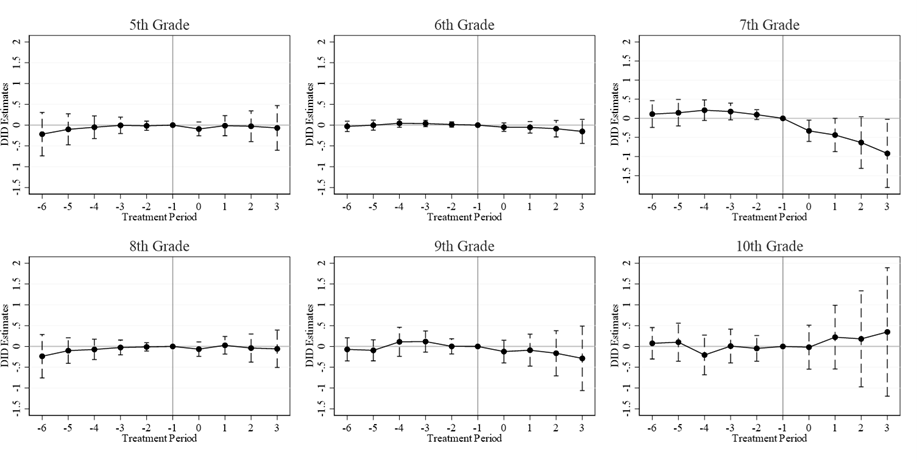
This finding is particularly meaningful for two reasons. First, girls in the seventh grade are generally around 12 to 13 years old, which corresponds to the average age at which menarche occurs in Kerala. The fact that the treatment is effective at reducing dropout rates at this grade level suggests that menstruation-related barriers to schooling are most acute during the early stages of puberty, when many girls first begin to menstruate. Without adequate access to sanitary products, these girls are more likely to miss school or disengage entirely. Second, the absence of significant treatment effects in higher grades likely reflects the fact that girls most at risk of dropping out due to menstrual challenges may have already left school prior to treatment.
Importantly, the magnitude of the programme’s impact on seventh grade girls increases over time, suggesting that continued access to free sanitary pads at schools not only delivers sustained benefits but also encourages ongoing school attendance. These results underscore the value of long-term, government-led interventions in addressing structural barriers to girls’ education, particularly when such programmes provide dependable, recurring support to those most in need.
Attendance: The mechanism behind school retention
Why might free sanitary pads reduce dropout rates among girls? One plausible explanation is that access to free sanitary pads enables girls to manage their menstruation safely and comfortably, reducing the need to stay home during their periods. Moreover, because the pads are distributed at school, this regular in-school provision may serve as an additional incentive for girls to attend classes and remain enrolled. To examine this mechanism, we utilise hand- collected attendance data from a subsample of treated schools. Compared to same-grade boys in the same schools, attendance rates for seventh grade girls increased by 22.6 percentage points following programme implementation.
We also investigate several alternative explanations for the observed treatment effects. One possibility is that the programme helped reduce menstrual stigma in mixed-gender schools, creating a more supportive learning environment for girls. However, we find larger effects in girls-only schools and those with fewer male students, suggesting this is unlikely. Another hypothesis is that improved access to sanitary products benefited female teachers or led family members to encourage school attendance for their own gain. Yet, stronger effects in schools with fewer female teachers and small student populations – where pad collection is easier to monitor – do not support these channels. Taken together, the evidence strongly indicates that the impact of free sanitary pad provision on girls’ educational outcomes operates directly through the girls themselves.
Next, we examine heterogeneity in treatment effects and find that reductions in dropout rates are more pronounced in rural schools, public schools, and schools with a higher proportion of students from backward castes – proxies for institutions serving students from lower-income or economically disadvantaged backgrounds – compared to their urban, private, and forward- caste counterparts. These findings suggest that the provision of free sanitary pads effectively addresses affordability barriers associated with menstrual hygiene products.
Policy implications for menstrual hygiene management programmes
Our research shows that the free provision of sanitary pads through schools significantly reduces dropout rates among adolescent girls, especially those in seventh grade who are entering puberty. We also document increased attendance and larger treatment effects in rural, public, and backward caste schools, suggesting greater benefits for girls from economically disadvantaged backgrounds.
Given ongoing efforts by governments and nongovernmental organisations worldwide to improve menstrual hygiene management, our findings highlight the need for sustained and scalable delivery models. Improving access alone may not be sufficient; regular provision of free sanitary pads through schools promotes consistent attendance and strengthens girls’ commitment to education.
References
Agarwal, S, LE Chia, and P Ghosh (2024), “Do sanitary pads improve girls' educational outcomes?,” Review of Economics and Statistics: 1-54.
Castro, S and K Czura (2025), “Managing menstrual hygiene: The economics of period poverty,” VoxDev.
Dasra (2015), “Spot on: Improving menstrual management in India.”
Montgomery, P, CR Ryus, CS Dolan, S Dopson, and LM Scott (2012), “Sanitary pad interventions for girls’ education in Ghana: A pilot study,” PLoS One 7(10): e48274.
Montgomery, P, J Hennegan, C Dolan, M Wu, L Steinfield, and L Scott (2016), “Menstruation and the cycle of poverty: A cluster quasi-randomised control trial of sanitary pad and puberty education provision in Uganda,” PLoS One 11(12): e0166122.
Oster, E, and R Thornton (2011), “Menstruation, sanitary products, and school attendance: Evidence from a randomized evaluation,” American Economic Journal: Applied Economics 3(1): 91–100.
Phillips-Howard PA, E Nyothach, FO ter Kuile, J Omoto, D Wang, C Zeh, C Onyango, et al. (2016), “Menstrual cups and sanitary pads to reduce school attrition, and sexually transmitted and reproductive tract infections: A cluster randomised controlled feasibility study in rural western Kenya,” BMJ Open 6(11): e013229.
UNESCO (2014), “Puberty education and menstrual hygiene management.”
World Bank (2018), “Menstrual hygiene management enables women and girls to reach their full potential.”