




After adjusting for labour input differences, the apparent agricultural productivity gap in India is largely a formal-informal sector divide. Differences in education and labour hours fully explain the productivity gap between informal sector and agriculture. If these are addressed, incomes can increase even without convergence to formal sector productivity levels.
Editor’s note: For a broader synthesis of themes covered in this article, check out Issue 2 of our VoxDevLit on Informality. The authors have made slides available here.
Almost all countries have experienced a broad decline in the agricultural share of employment and output along their development path (Amodio et al. 2026). This stylised fact has an immediate policy implication: given a fixed set of input resources, reallocating labour from agricultural to non-agricultural sectors can raise value added per worker and, consequently, living standards.
Across countries, productivity in the non-agricultural sector is, on average, 3.5 times higher than the productivity in the agricultural sector (Gollin et al. 2014). The situation is worse for the poorest quartile of countries: the productivity gap rises nearly to six, compared to about two for the richest quartile. This gap in productivity has been called the agricultural productivity gap (APG).
Could the APG be a consequence of over-estimating labour input in agriculture? Workers in agriculture are generally less educated. On a yearly basis, hours worked in agriculture tend to be lower than in non-agriculture because of seasonality in weather. Would the APG disappear if the comparison controlled for effective labour input? On a macroeconomic level, Gollin et al. (2014) compute productivity gaps between agricultural and non-agricultural sectors across countries while accounting for differences in labour inputs. Even though the APG reduces, the corrected productivity gap remains substantial.
Research has debated whether these productivity gaps are exogenous, reflecting mobility barriers, or whether they are endogenous, arising from self-selection into high-productivity sectors. Implicitly, the evidence base treats the non-farm sector as homogenous when it is not. In developing countries, most non-agricultural employment is informal. This raises the question of whether the productivity gap is driven by formal sector firms, which are few in number but economically significant. In our research (Jat and Ramaswami 2026), we compare the productivity of agriculture to the informal and formal non-farm sectors in India.
Our comparison controls for sectoral differences in hours worked, human capital, and labour share of value added. We find substantial productivity gaps with the formal sector but small and negligible gaps with the informal non-farm sector. About two-thirds of non-farm workers are in sectors not more productive than the agricultural sector. These findings suggest that the primary dualism in development is between the formal non-farm sector and the informal sector including agriculture.
Non-agriculture is not a homogeneous category
The non-agricultural sector in developing countries varies substantially, with a large informal sector consisting of small firms, while larger firms make up a small portion of employment but a larger share of income (Ciani et al. 2020). In 2017, informal enterprises accounted for 43% of non-farm GDP and 68% of non-farm employment in India (Murthy 2019, Nagaraj and Kapoor 2022). These figures highlight a disparity like the agricultural share of employment versus GDP, suggesting that the APG may differ depending on whether the comparison is with formal or informal non-farm segments. These comparisons therefore merit a nuanced investigation of the productivity gap.
We probe these disparities further. Following the methods of Gollin et al. (2014), we adjust the gap in value added per worker for sectoral differences in human capital and in hours worked. However, unlike Gollin et al. (2014), we also adjust for the sector's labour share of value added, ensuring a more accurate comparison. We use a disaggregation of the non-farm sector in 2 sub-sectors to identify (primarily) formal and (primarily) informal segments and estimate their productivity relative to agriculture. In a second approach, we use a 24-sector disaggregation to estimate non-parametrically, by sub-sector, the relation between informality and the agricultural productivity gap.
So where is the agricultural productivity gap?
We find a negligible productivity gap between the farm sector and the informal non-farm sector. However, the gap between the formal and informal non-farm sectors is significant, as is the gap between the formal non-farm sector and the farm sector. The following table reports the productivity gap relative to agriculture.
Table 1: Corrected APG
| Sector | 1999-00 | 2004-05 | 2011-12 | 2018-19 | 2022-23 |
| Primarily Informal Non-Farm Sector | 1.34 | 1.37 | 1.09 | 1.11 | 1.08 |
| Primarily Formal Non-Farm Sector | 2.55 | 2.28 | 1.62 | 1.40 | 1.78 |
Note: Productivity Gap is corrected for differences in labour input and differences in labour shares.
Values greater than one indicate a sector is more productive than agriculture. The data shows minimal productivity differences for the primarily informal non-farm sector, while the formal non-farm sector exhibits a substantial gap. This suggests that the primary dualism lies between the informal and formal sectors rather than between farm and non-farm sectors.
For further disaggregation of the non-agricultural sector, our non-parametric analysis estimates the productivity gap as a function of informality. Our results show a negative relationship between productivity and informality. When informal workers make up over 76% of a sub-sector, we cannot reject the hypothesis of no productivity gap. Figure 1 illustrates this relationship.
Figure 1: Agricultural productivity gap as a function of employment proportion in the informal sector
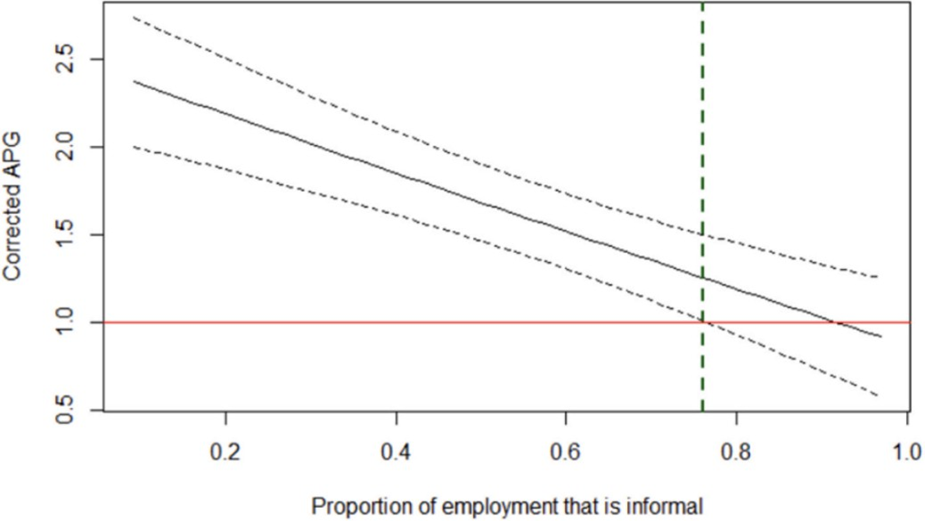
Note: The graph shows that the productivity gap decreases as informality increases.
Why does it matter?
Non-farm activities whose APG is not statistically different from 1 account for about two-thirds of non-farm employment. This suggests that the APG debate should focus on the gap between formal and informal sectors, rather than solely on the agriculture versus non-agriculture divide.
Though our analysis is based on Indian data, it is likely to have broader relevance, as many low-income countries also have a large informal sector (Bonnet et al. 2019). Given the prevalence of small, unproductive enterprises in developing economies (La Porta and Shleifer 2014), similar results are likely in other economies.
Even if productivity gains from switching to the informal non-farm sector are modest or negligible, the informal sector offers better jobs to better educated workers and employment all year round. For these reasons, even the limited structural transformation (from agriculture to informal non-farm) lead to income gains. Policies that would promote such outcomes include strengthening human capital investments, expanding agricultural investments, and lowering the costs of seasonal migration. Micro-level studies have established the income gains from temporary migration during the agricultural lean season (Bryan et al. 2014, Imbert and Papp 2020). These gains will necessarily not be of the same order as the productivity gaps with the formal sector. However, the latter may not be achievable if the gaps are because of self-selection.
References
Amodio, F, M Poschke, B Caprettini, J Choi, H Huang, Y-H Lei, T Reed, R Rodrigo, L F Sáenz, M Sanfilippo, M Schwartzman, G de Souza, M Sposi, and V Wiedemann (2026), “Industrial development,” VoxDevLit, 22(1).
Bonnet, F, J Vanek, and M Chen (2019), “Women and men in the informal economy: A statistical brief,” International Labour Office.
Bryan, G, S Chowdhury, and A M Mobarak (2014), “Underinvestment in a profitable technology: The case of seasonal migration in Bangladesh,” Econometrica, 82(5): 1671–1748.
Ciani, A, M C Hyland, N Karalashvili, J L Keller, and T T Tran (2020), “Making it big: Why developing countries need more large firms,” World Bank.
Gollin, D, D Lagakos, and M E Waugh (2014), “The agricultural productivity gap,” Quarterly Journal of Economics, 129(2): 939–993.
Imbert, C, and J Papp (2020), “Costs and benefits of rural-urban migration: Evidence from India,” Journal of Development Economics, 146: 102473.
Jat, R, and B Ramaswami (2026), “The agricultural productivity gap: Informality matters,” Journal of Development Economics, 178: 103617.
La Porta, R, and A Shleifer (2014), “Informality and development,” Journal of Economic Perspectives, 28(3): 109–126.
Murthy, S R (2019), “Measuring informal economy in India: Indian experience,” IMF Statistical Forum.
Nagaraj, R, and R Kapoor (2022), “What is ‘formalisation of the economy’? India’s quest to shrink its informal sector,” India Forum.