





Evidence from Ethiopia suggests that while part-time jobs broaden access for workers needing flexibility, they attract lower-skill applicants and reduce productivity, helping explain part-time wage penalties and gender pay gaps.
Though part-time work offers employees flexibility, it often comes with a trade-off unbeknownst to firms: lower productivity. As part of a large-scale field experiment in rural Ethiopia, we tested how identical jobs, offered as either part-time or full-time, attract different applicants, and shape performance (Kim, Kim, and Zhu 2025). Our results provide insights for wage gaps, gender inequality, and the design of labour policies around work hours.
The experiment: Identical jobs, different hours
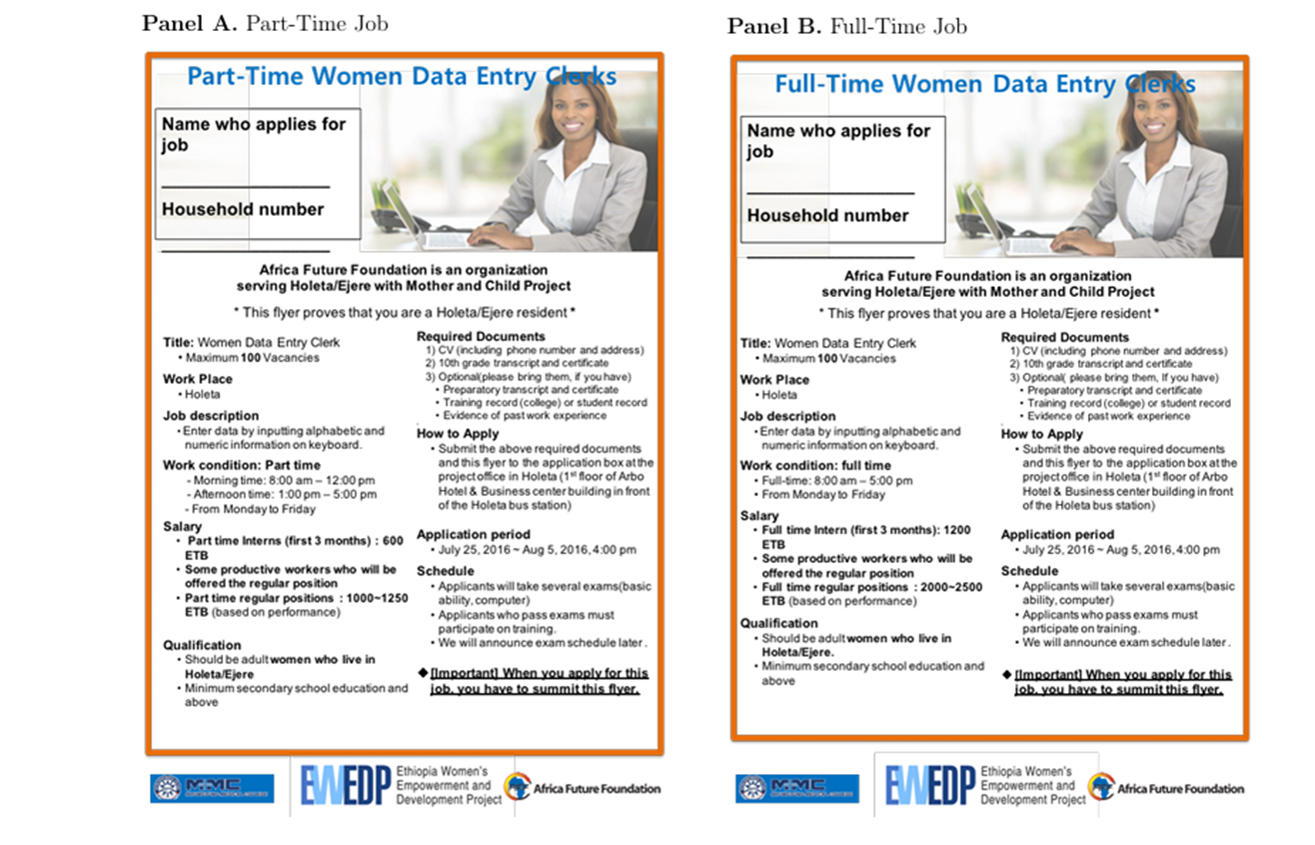
We partnered with an NGO to run a randomised recruitment drive for data-entry jobs. Villages were randomly assigned to receive part-time (4 hours/day) or full-time job ads (8 hours/day). All other features were identical – same tasks, qualifications, and hourly pay – isolating hours as the only difference (Figure 1).
Over 6,000 women learned about the openings, and 456 applied by submitting résumés. All applicants took aptitude tests and surveys. To measure actual job performance, everyone was invited to a paid internship, where productivity was tracked through data-entry tasks. This design let researchers see who applied and how well they worked.
Figure 1: Jobs ads
Who applies to part-time jobs?
The part-time postings attracted workers with lower skills. Applicants in the part-time group scored around 0.2 standard deviations lower on data-entry and manual dexterity tests than those in the full-time group. At the same time, these candidates expressed stronger preferences for flexibility, such as balancing family obligations.
Since pay was identical, this reflects pure self-selection effects of differential work hours. Higher-skill workers were more likely to apply for full-time jobs, while those needing flexibility, who on average have lower skills, gravitated toward part-time openings.
Productivity differences on the job
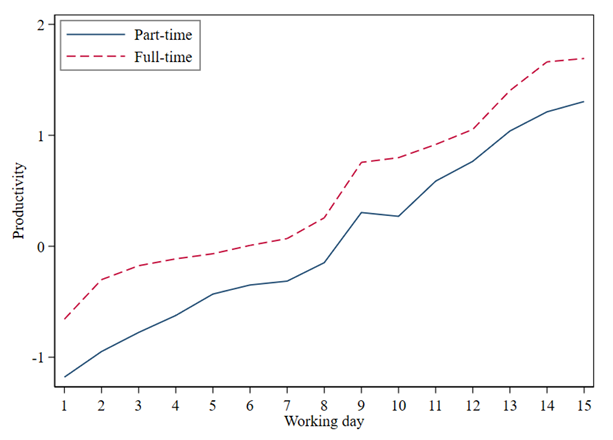
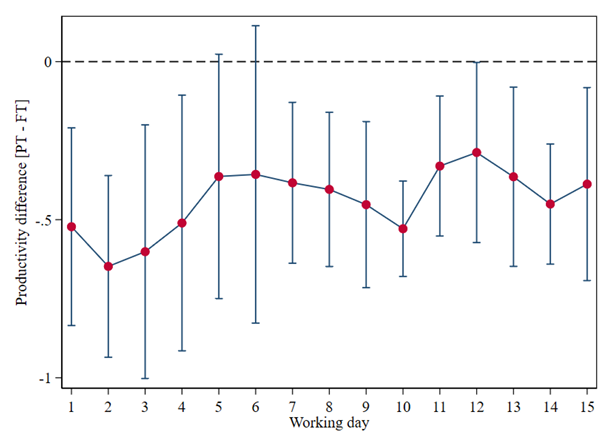
These differences in skills translated into real productivity gaps. During the internship, part-time recruits typed and entered data more slowly and less accurately than their full-time counterparts.
The gap was especially pronounced among the top performers. The very best workers were far more likely to come from the full-time pool, suggesting that high-ability individuals rarely choose part-time positions (Figure 2).
This implies a trade-off for the firm: part-time jobs broaden access for those needing flexibility but reduce average workforce productivity.
Figure 2: Labour productivity of part- and full-time recruited interns
Panel A: Above-the-median interns
Panel B: Above-the-median interns – Difference between part- and full-time recruited interns
Explaining part-time and gender wage penalties
Globally, part-time workers earn around 25% less per hour than full-time workers. The Ethiopian experiment suggests that roughly half of this wage gap stems from self-selection: part-time jobs attract less productive workers.
Women, more often than men, shift to part-time work after having children. This magnifies pay differences between men and women because part-time work pays lower wages. Our findings suggest that this pay gap reflects, in part, the negative selection effect of part-time work on productivity.
Implications for labour policy
If only some firms offer shorter hours, they risk losing top talent to long-hour employers. Coordinated, economy-wide policies – such universal shorter workweeks – can reduce this negative selection effect on adopting firms.
While our research is based in a low-income setting, similar patterns likely exist elsewhere. Wherever skills vary and people value flexibility differently, and these characteristics are related, part-time jobs will tend to draw in those with lower productivity. The magnitude may differ across countries and occupations, but the core mechanism remains relevant for understanding wage patterns and designing labour policies.
References
Kim, H B, H Kim, and J Y Zhu (2025), “The selection effects of part-time work: Experimental evidence from a large-scale recruitment drive,” Review of Economics and Statistics, 1–46.