






Evidence from Uganda and Ethiopia suggests that host prejudice against refugees increases when refugees are perceived as direct job competitors, but not necessarily when actual competition exists.
Editor’s note: For a broader synthesis of themes covered in this article, check out our VoxDevLit on Refugees and Other Forcibly Displaced Populations.
Refugee integration is a critical policy challenge for many low- and middle-income countries, where 75% of the world’s refugees reside (UNHCR 2024), especially as many refugees are displaced from their home countries for years or even decades. In some contexts, refugee hosting policy seeks to encourage the inclusion of refugees into host society. But negative attitudes towards refugees may complicate such efforts. Given the common perception that refugees ‘steal’ jobs from locals, could perceived job competition exacerbate anti-refugee attitudes?
This question is especially salient in Uganda and Ethiopia, which host over 2.3 million refugees living alongside host communities in both urban and encampment settings. Both these countries have implemented inclusive refugee policies, such as granting refugees rights to work, freedom of movement, and access to public services (Blair et al. 2021). While such policies promote refugee self-reliance, their success does not only depend on legal rights but also on social acceptance and how host communities perceive their economic implications (Loiacono and Silva Vargas 2019, Alrababa’h et al. 2021).
Prior research in high-income contexts has debated whether anti-migrant attitudes are driven more by economic concerns or identity-based anxieties (Hainmueller and Hopkins 2014), but far less is known in low-income settings where host-refugee competition in informal labour markets may be more immediate and salient (Becker et al. 2022).
Our research (Bousquet et al. 2025) investigates whether the perception of job competition fuels negative attitudes between hosts and refugees. Competition for employment and resources is a common concern in refugee-hosting areas around the world, and Uganda and Ethiopia are no exception. We thus explore how economic similarity and group identity influence social attitudes in these two major refugee-hosting nations.
Using an experiment to understand attitudes toward refugees
To examine intergroup attitudes in contexts of potential economic competition, we conducted a randomised vignette experiment embedded in a large-scale labour market survey across Uganda and Ethiopia. We surveyed more than 4,700 individuals, both refugees and host nationals across two urban areas, Kampala (Uganda) and Addis Ababa (Ethiopia), and two rural settings, Nakivale/Isingiro in Uganda and Kebribeyah/Jijiga in Ethiopia.
Figure 1: Map of study locations
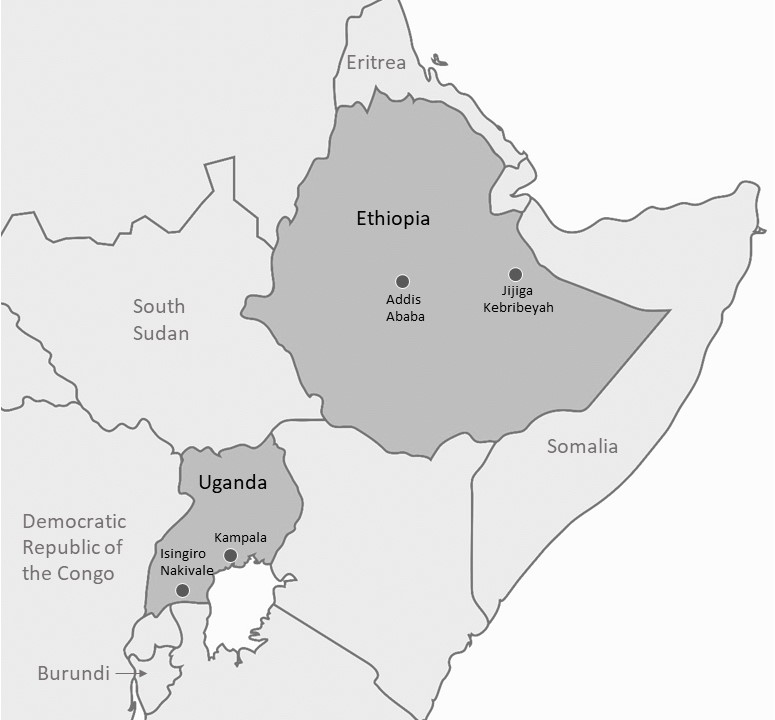
These sites vary in the timing and scale of refugee arrivals (for instance, more sudden in Addis Ababa, more gradual in Kampala), degree of labour market integration, and level of ethnic similarity between host communities and refugees. This variation allows us to assess the salience of local context in shaping social and economic interactions between hosts and refugees.
Each respondent was presented with a short narrative (a ‘vignette’) about a fictional jobseeker whose characteristics were randomly assigned to be either a host national or refugee working in the same occupation as the respondent or a different but similarly skilled one.
Figure 2: Vignette about fictional jobseeker
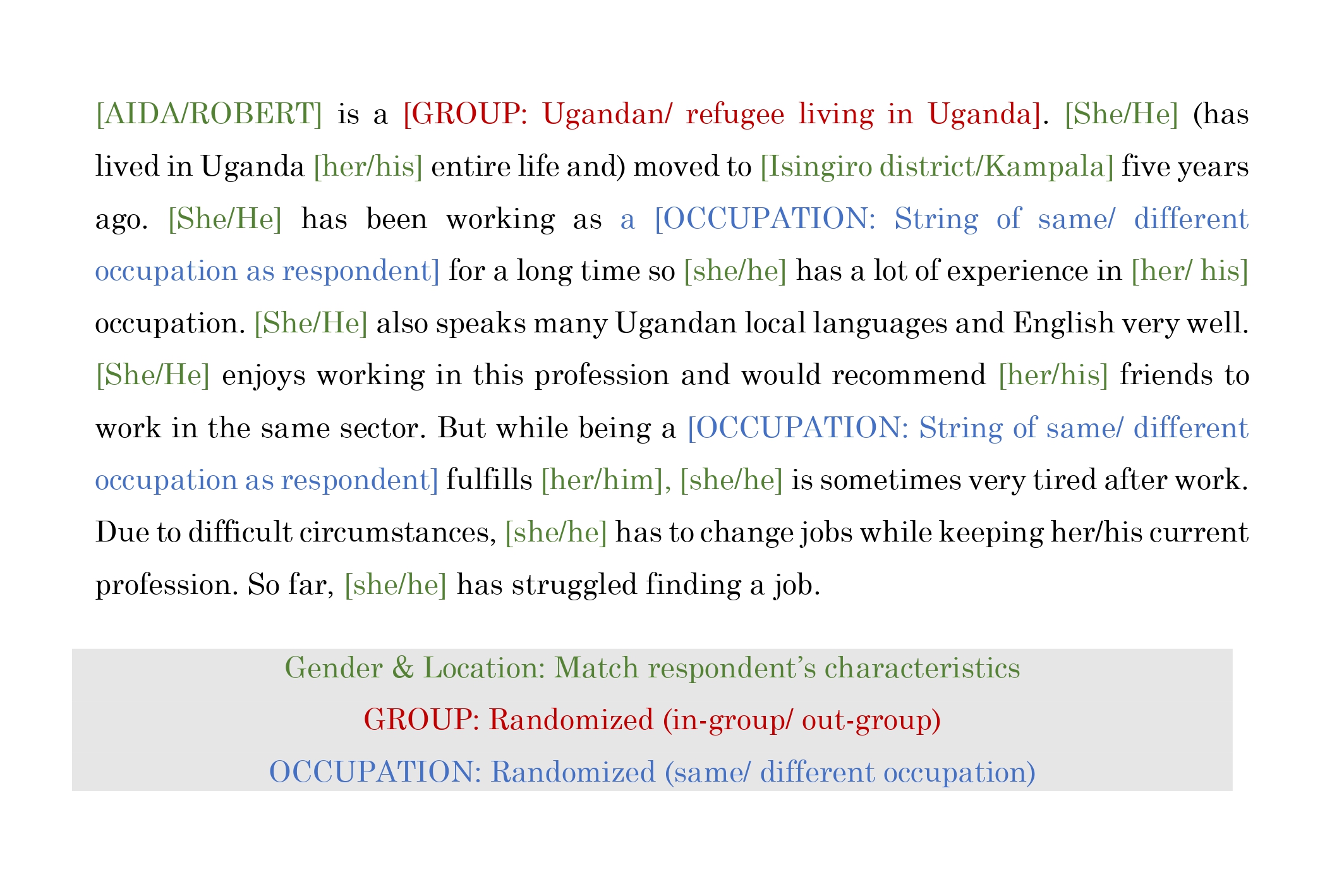
This enabled us to assess whether attitudes shift based on economic similarity and/or group identity. Respondents were then asked about their willingness to interact with the fictional individual socially (e.g. friendship), privately (e.g. marriage or family relations), and professionally (e.g. working with or for them). We compiled these responses into an index that captures the extent of negative bias toward the fictional jobseeker.
Perceived job competition increases host prejudice against refugees
When hosts were presented with a refugee working in a different occupation, their responses did not differ significantly from those presented with a fellow host character. This suggests that refugee status alone does not trigger more negative views. However, when the refugee character shared the host respondent’s occupation, attitudes became notably more prejudicial.
Figure 3: Main results
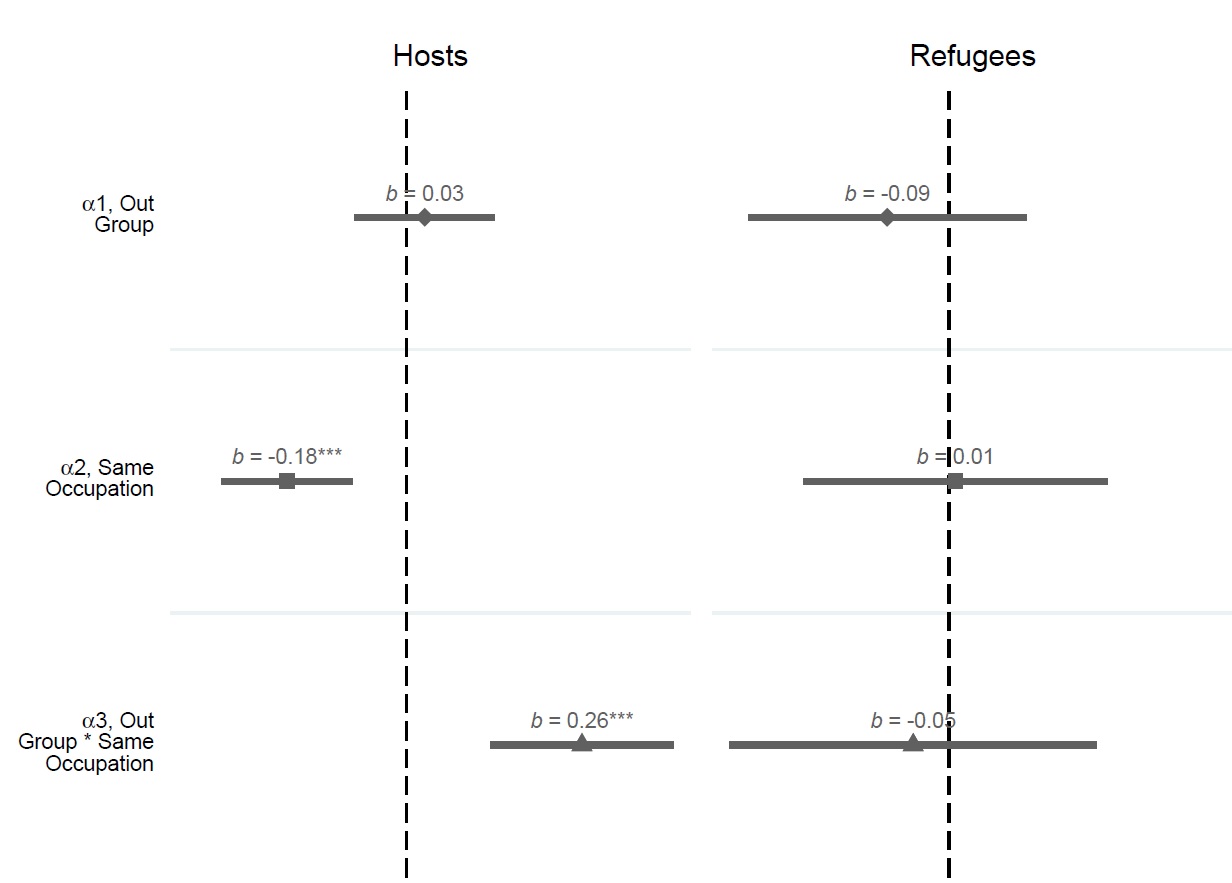
Our results suggest that shared occupational identity can reduce prejudice within groups but may heighten tensions between groups, as the perception of job competition triggers out-group prejudice. Among refugee respondents, attitudes did not vary significantly based on the vignette character’s group or occupation, though smaller sample sizes may limit statistical power.
Context matters for understanding prejudice in refugee hosting areas
Disaggregated results show that the link between economic competition and out-group bias varies by local context. In Addis Ababa, host respondents exhibited generally inclusive attitudes towards refugees, unless the refugee character shared their job. The recent arrival of Eritrean refugees has likely intensified concerns about job competition. Even though they make up a small share of the population, their perceived visibility may still contribute to a heightened sense of threat. This is consistent with research linking rising prejudice to periods of social stress or perceived demographic shifts (Allport 1954).
In rural Isingiro/Nakivale, the attitudes of host respondents were consistently negative, regardless of the refugee’s occupation—pointing to broader social tensions. The area hosts a large, long-term refugee population under Uganda’s self-reliance model, which promotes shared use of land and services. Hosts may feel pressure over scarce agricultural resources, fuelling resentment beyond formal labour markets. This echoes findings that inclusive policies can backfire if locals feel they bear the costs (Omata 2022).
In contrast, in Kampala and Jijiga/Kebribeyah, the attitudes of host respondents were more stable across scenarios. In Kampala, refugees work across diverse sectors while in Jijiga/Kebribeyah, cultural and ethnic ties may ease tension.
Overall, this highlights the importance of tailoring refugee policies to local social and economic dynamics, not just national frameworks.
Social contact and ethno-linguistic proximity reduce hosts’ prejudice against refugees
Interpersonal contact and cultural proximity play a key role in shaping refugee-host relations. Host respondents without refugee friends were significantly more likely to express prejudice when a refugee character shared their job. Conversely, those with even minimal out-group contact expressed more neutral attitudes—consistent with research showing that social interaction reduces bias through perspective-taking (Lowe 2021, Betts et al. 2023).
Prejudice was also more concentrated among hosts who did not share the same language or ethnicity as the refugees in their community. In regions like Jijiga/Kebribeyah, where hosts and refugees are both Somali, attitudes were markedly more inclusive. This suggests that programmes promoting inter-group contact or leveraging shared cultural ties may help reduce tensions. While such interventions are not a panacea, they could complement existing labour market and social protection efforts by targeting the relational and psychological roots of anti-refugee sentiment.
Perceived, rather than actual, labour market competition determines prejudice
Our findings suggest that prejudice toward refugees is driven more by perceived competition than actual labour market overlap. This pattern holds even when we shift from location-level comparisons to individual-level analysis: we observe the strongest bias among host respondents in sectors where few refugees actually work. This reinforces the idea that perceptions of competition—rather than real labour market exposure—are key to understanding hostile attitudes.
This mismatch between perception and reality highlights the risk of scapegoating, where refugees are blamed for economic stressors they do not materially contribute to (Savun and Gineste 2019).
Addressing misperceptions to strengthen inclusion
Our findings suggest that negative attitudes toward refugees are often shaped more by perceived than actual job competition, particularly in contexts where direct competition is minimal. This points to the importance of addressing misperceptions rather than restricting refugee labour market access. Informational efforts that correct false beliefs about refugees’ economic impact may help. In parallel, fostering contact between hosts and refugees—particularly in settings that encourage collaboration—may help challenge entrenched stereotypes that contribute to negative attitudes and scapegoating. Programmes that create shared goals or opportunities for cooperative engagement could be promising in reshaping attitudes. While further research is needed to tailor such approaches to specific local dynamics, these insights underscore the value of socially oriented strategies that build mutual understanding and reduce unfounded fears in contexts of displacement.
References
Allport, G W (1954), "The Nature of Prejudice", Reading: Addison-Wesley.
Alrababa’h, A, A Dillon, S Williamson, J Hainmueller, D Hangartner and J Weinstein (2021), “Attitudes toward migrants in a highly impacted economy: Evidence from the Syrian refugee crisis in Jordan,” Comparative Political Studies, 54(1): 33–76.
Becker, M, F Krüger and T Heidland (2022), “Country, culture or competition: What drives attitudes towards immigrants in Sub-Saharan Africa?”, Unpublished manuscript.
Betts, A, M F Stierna, N Omata and O Sterck (2023), “Refugees welcome? Inter-group interaction and host community attitude formation,” World Development, 161: 106088.
Blair, C W, G Grossman and J M Weinstein (2022), “Liberal displacement policies attract forced migrants in the global south,” American Political Science Review, 116(1): 351–358.
Bousquet, J, A Gasten, M M Kadigo, J F Maystadt and C Salemi (2025), “Does perceived labor market competition increase prejudice between refugees and their local hosts? Evidence from Uganda and Ethiopia,” Journal of Development Economics, 175: 103481.
Hainmueller, J and D J Hopkins (2014), “Public attitudes toward immigration,” Annual Review of Political Science, 17: 225–249.
Loiacono, F and M Silva Vargas (2019), “Improving access to labor markets for refugees: Evidence from Uganda,” International Growth Centre (IGC).
Lowe, M (2021), “Types of contact: A field experiment on collaborative and adversarial caste integration,” American Economic Review, 111(6): 1807–1844.
Omata, N (2022), “Rethinking self-reliance and economic inclusion of refugees through a distributive lens: A case study from Uganda,” African Affairs, 121(485): 649–674.
Savun, B and C Gineste (2019), “From protection to persecution: Threat environment and refugee scapegoating,” Journal of Peace Research, 56(1): 88–102.
UNHCR (2024), "Global Trends: Forced Displacement in 2023".